
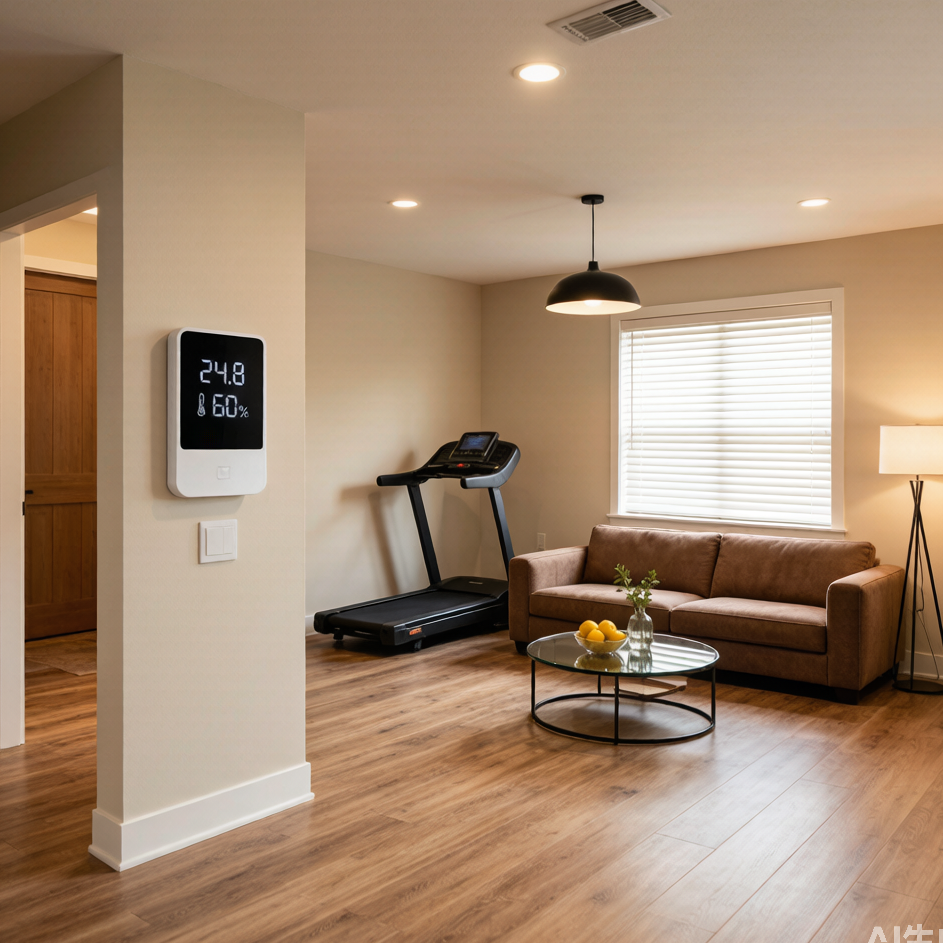
The basement is where most homes hide their combustion equipment — the furnace, the water heater, sometimes a generator or a workshop with gas tools. That makes it one of the most common *origins* of carbon monoxide in a house. Yet plenty of homeowners never place a basement CO alarm down there, assuming the alarm in the bedroom upstairs is enough. By the time CO reaches the bedroom, it has already filled the lower half of your home.
Why the basement is a hidden CO source
Carbon monoxide is produced any time a fuel burns incompletely. Basements concentrate several of the highest-risk sources under one roof:
- The furnace. A cracked heat exchanger or a blocked flue can quietly push CO into the air instead of up the chimney.
- The water heater. Gas-fired units run for long stretches and often sit in an unfinished mechanical area with poor airflow.
- Generators and gas tools. During a power outage, a portable generator in or near the basement is a well-known CO culprit if exhaust is not vented outdoors.
- Stack effect. Warm air leaving the top of the house pulls air — and any CO — upward from the basement through stairwells,utility chases, and gaps into the floors where your family lives.
A dedicated carbon monoxide detector in basement placement catches the leak at the source, not after it has climbed through the house.
Finished vs. unfinished basements
Whether your basement is a finished rec room or a raw mechanical space changes the risk picture:
- An unfinished basement holds the furnace and water heater directly. The danger is close to the equipment, but the space is often unmonitored and rarely visited.
- A finished basement used as a bedroom, gym, or office adds sleeping and breathing time down there — so a CO alarm for finished basement use is not optional if anyone spends hours or sleeps in that space.
Either way, CO does not respect finished walls. A detector near the mechanical equipment protects both the basement and every floor above it.
What to look for in a basement CO alarm
Basements are damp, dusty, and temperature-swung, so the right detector differs from a bedroom unit:
- Combined sensing. Many basements also store gasoline, propane tanks, or paint thinners. A 6-in-1 unit that senses natural gas and propane leaks *and* smoke *and* CO covers more of the real risks in one device.
- Temperature & humidity readout. Basements swing from damp to dry and cold to warm. A sensor that shows live temperature and humidity helps you spot moisture problems or frozen-pipe risk early. (Note: the temp/humidity display is an added convenience reading, not part of the CO safety certification.)
- Flexible mounting. Basement walls are often concrete or crowded with piping. A compact detector with a magnetic mount or simple screw plate installs without drilling into finished surfaces.
- Battery backup. Furnaces and generators misbehave most during storms and outages — exactly when you still need protection.
- Standards. Look for devices tested to UL 2034 for CO, UL 1484 for combustible gas, and UL 217 for smoke, and that are CE & FCC certified for the markets they ship to.
Where to install a carbon monoxide detector in the basement
Placement matters as much as the device:
- Mount it on the wall near the mechanical equipment (furnace/water heater) but not directly on top of an exhaust vent or flue.
- Keep it in the breathing zone, roughly 5 feet above the floor, away from dead-air corners where air never circulates.
- If the basement is finished and used as a bedroom or office, add a second alarm in that living area — not just by the equipment.
- Do not place it right next to a furnace exhaust or in a sealed utility closet where air cannot reach the sensor.
Testing and maintenance
A detector only protects you if it works:
- Test monthly with the test button.
- Replace batteries on schedule, and replace the whole unit every 7–10 years per the manufacturer.
- Never ignore chirps or end-of-life warnings — they mean the device needs attention now.
Related reading
- Garage Carbon Monoxide Detector: Why Your Attached Garage Needs One (2026)
- The Complete RV Carbon Monoxide Detector Guide (2026)
- Why Your Carbon Monoxide Detector Should Also Show Temperature & Humidity
Watch the basement and the floors above it
The VASAIKO HD16 is a 6-in-1 smart detector that combines carbon monoxide, natural gas, propane, and smoke sensing with a live temperature and humidity display, a digital readout, a magnetic mount, and battery backup. It is built to watch your basement mechanical room and your living space from one compact device. See how it fits your setup on our HD16 safety detector page.