
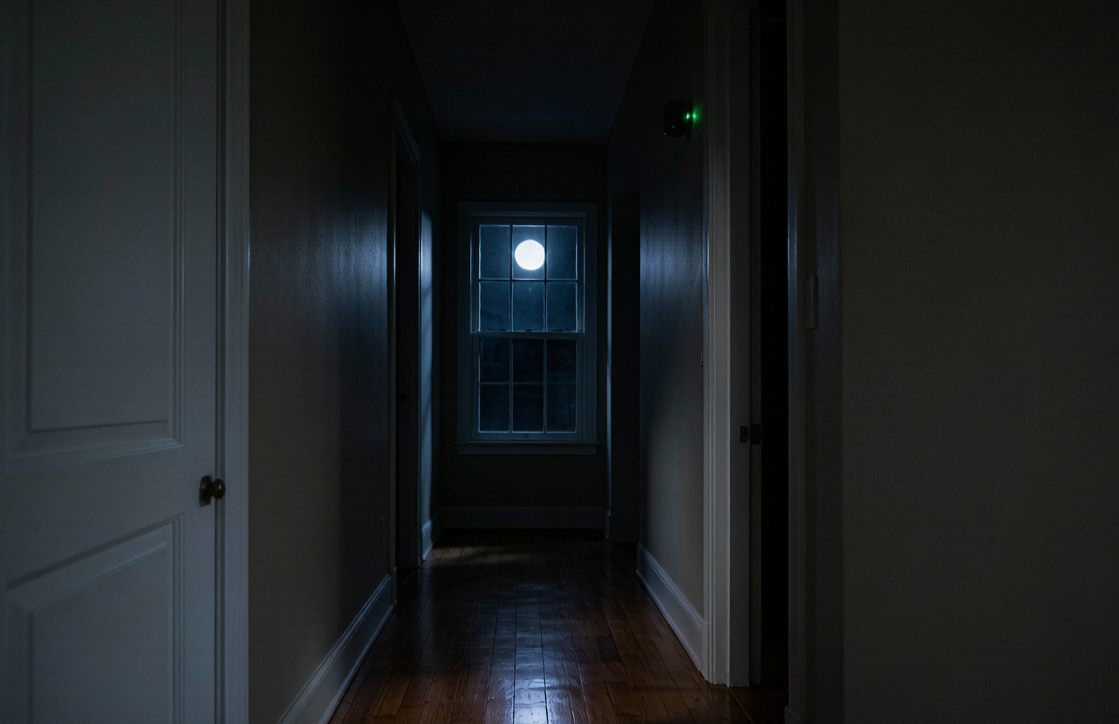
A carbon monoxide detector beeping at 3am is one of the few household noises that is genuinely dangerous to guess at. Most people assume it is the battery, pull the unit off the wall, and go back to sleep. Sometimes that is correct. Sometimes it is the last decision they get to make casually.
The difference between "annoying" and "evacuate now" is encoded in the beep pattern itself, and it takes about ten seconds to read once you know what to listen for.
First: is it beeping, or chirping?
Every certified CO alarm distinguishes between two completely different signals. Learning to tell them apart is the single most useful safety skill in this article.
An alarm is loud, fast, and continuous. Four rapid beeps, a pause of roughly four to five seconds, then four more — repeating and refusing to stop. It is designed to wake a sleeping adult through a closed door at 85 decibels. You will not mistake it for a maintenance signal.
A chirp is a single short tone, isolated, spaced 30 to 60 seconds apart. It is quiet by comparison and almost lazy in its rhythm. This is the unit telling you it needs service, not warning you about gas.
If you are unsure which one you are hearing, treat it as an alarm and get outside. A false evacuation costs you fifteen minutes. The alternative does not have a comparable downside.
The complete beep pattern reference
Patterns are largely standardized under UL 2034 for CO and UL 217 for smoke, but manufacturers add their own end-of-life and fault codes. Always confirm against your specific manual. As a general reference:
| Pattern | Meaning | Action |
| --- | --- | --- |
| 4 beeps + pause, repeating | Carbon monoxide detected at a dangerous level | Evacuate immediately, call emergency services |
| 3 beeps + pause, repeating | Smoke detected (on combination units) | Evacuate, treat as fire |
| 1 chirp every 30–60 seconds | Low battery | Replace the battery |
| 5 chirps every 60 seconds | End of sensor life — unit must be replaced | Replace the whole unit |
| 1 chirp every 30 seconds, no battery cause found | Sensor fault or malfunction | Replace the unit |
| Rapid continuous chirping, no pattern | Unit error or wiring fault on hardwired models | Check power, then replace |
| A single beep on power-up | Normal self-test confirmation | None |
The two patterns people confuse most often are 4 beeps (CO alarm) and 5 chirps (end of life). Four is an emergency. Five means the sensor has aged out and is no longer trustworthy. A unit signalling end of life is not protecting you, even though it is still on the wall making noise.
If your alarm is a combination model that also covers combustible gas, check whether it uses a separate pattern for a gas leak — most do. The response to a gas leak differs from the response to CO in one critical respect: you do not operate light switches or anything that can spark. The full sequence is in Home Gas Leak Detector: A Room-by-Room Placement Guide.
If it is a real CO alarm: the eight-step response
Four beeps repeating means the unit has measured carbon monoxide above its alarm threshold. Do this in order, without stopping to investigate:
- Get everyone out. All people, all pets, immediately. Do not gather belongings.
- Do not open windows on the way out. This is counterintuitive, but ventilating before responders arrive can disperse the gas enough to hide the source, and it costs you time you should be spending leaving.
- Move to fresh air and stay there. Outdoors, or a neighbour's home. Not the garage, not the porch of the affected house.
- Call 911 or your local emergency number from outside. Say "possible carbon monoxide" — it changes what equipment they bring.
- Do a headcount and check for symptoms. Headache, dizziness, nausea, confusion, weakness, blurred vision. If anyone is confused, unsteady, or unconscious, tell the dispatcher — that is a medical emergency, not just an alarm call.
- Do not re-enter for any reason. Not to silence the alarm, not to turn off the furnace, not to grab a phone charger.
- Let responders clear the building. They carry calibrated meters and will identify the source.
- Find and fix the cause before restoring the appliance. A CO alarm that goes off once will go off again if the furnace, water heater, or vehicle that caused it is unchanged.
Anyone who was exposed and is showing symptoms should be evaluated medically, even if they feel better in fresh air. This article is safety guidance, not medical advice — when in doubt, get checked.
Why is my CO detector chirping? Seven causes, in order of likelihood
If you have confirmed it is a chirp and not an alarm, work through these:
1. Low battery
By far the most common cause. On battery-only units, the cell has dropped below the threshold. On plug-in units, the backup battery has — the unit still has mains power, but it chirps because the backup is what keeps it alive during an outage, which is exactly when CO risk peaks.
Replace with a fresh alkaline battery of the specified type. Do not use a partly-used battery from a remote control; the chirp will return within weeks.
2. End of sensor life
Electrochemical CO sensors degrade continuously from the day they are manufactured, whether or not they are ever exposed to gas. Most units carry a rated life of 5 to 10 years, printed on the back of the housing along with a manufacture date.
An end-of-life chirp cannot be reset. Some units let you silence it temporarily; that silence is not a fix. Check the date on the housing — if the unit is near or past its rated life, replace it. A detector kept past end of life is decoration.
3. The 3am temperature drop
This one causes an enormous amount of confusion, and it has a genuine physical explanation.
Battery voltage falls as temperature falls. Household temperatures typically hit their low between 2am and 6am, when the heating has cycled down and outdoor temperature is at minimum. A battery sitting just above the low-battery threshold during the day drops below it in the small hours — and the unit starts chirping.
So: your detector is not haunted, and it is not chirping *because* it is night. It is chirping because that is when the battery is coldest. The fix is the same as cause 1, and it is worth doing before winter rather than during it.
4. Dust, grease, or insects in the sensor chamber
Airborne particulate accumulates in the sensing chamber over years and can trigger a fault code. Kitchens and garages are the worst offenders — cooking aerosol and vehicle exhaust particulate both coat sensor elements. Vacuum the exterior vents gently with a soft brush attachment every few months. Never use compressed air, water, or cleaning sprays on a CO detector.
5. Humidity and temperature outside the rated range
Electrochemical sensors contain an electrolyte, and they have a rated operating envelope — commonly around 40°F to 100°F and 10% to 90% relative humidity. Units mounted in unconditioned garages, damp basements, or directly above a bathroom door can drift outside that range and fault.
This is a placement problem, not a hardware defect. A detector that displays live temperature and humidity readings makes it obvious when the environment is the problem — the reasoning behind that is covered in Why Your Carbon Monoxide Detector Should Also Show Temperature & Humidity. Damp basements in particular need careful siting, as discussed in Basement CO Alarm.
6. Loose battery door or poor contact
A battery compartment that is not fully latched, or contacts that have oxidised, can produce intermittent low-battery chirps even with a fresh cell. Open it, check the terminals for green or white residue, clean gently with a dry cloth, and re-seat firmly.
7. Residual alarm memory
Many CO alarms store the peak reading from the last event and will indicate that a CO event occurred, even after the air has cleared. This is a feature, not a fault — it tells you something happened while you were out. Clear it with the reset button once you have identified the cause. If you cannot identify a cause, do not clear it and assume nothing happened.
How to silence a chirping detector safely
There is a right order here:
- Confirm the pattern. Chirp, not alarm. If there is any ambiguity, evacuate first.
- Press the test/silence button once. On most units this quiets a low-battery chirp for 8 to 12 hours — enough to sleep, not a repair.
- Replace the battery within that window. The silence period exists so you can buy a battery in the morning, not so you can ignore it until next month.
- Hold the reset button for 15–20 seconds after replacing the battery, if your manual specifies it. If you want to know what that button actually proves — and what it does not — the monthly routine in how to test a carbon monoxide detector covers both. Some units need a full reset to clear the low-voltage flag.
- Run a test cycle. Press and hold test until the alarm sounds, then release. Confirm you hear the full alarm pattern at full volume.
- If the chirp returns within 24 hours with a new battery, the unit has failed. Replace it. Do not remove the battery and leave it on the wall — that is the most common way a household ends up with zero working CO protection.
Never solve a chirp by permanently removing the battery or unplugging the unit. It is a well-documented pattern in CO incident reports: a detector was present, and its battery had been removed weeks earlier because it chirped.
When the beeping is not your CO detector
Before you replace a working unit, rule out the other things in a modern home that chirp at similar intervals:
- Smoke alarms on the same or an adjacent floor — patterns are similar and sound travels
- Interconnected alarm systems, where one faulting unit makes the whole chain chirp
- Security panel low-battery warnings
- UPS or battery backup units for computers and routers
- Smart thermostats, water leak sensors, and appliance timers
- A dying smoke alarm two rooms away — the most common misattribution of all
Stand directly under the CO detector and listen. If the sound is not obviously coming from it, walk the house before you buy anything.
Why a live digital readout ends the guessing
The underlying problem with a beep-only detector is that it is a binary device attempting to describe a continuous variable. It is silent at 25 ppm, silent at 60 ppm, and then suddenly alarming — with no information about what happened in between.
That matters because low-level chronic CO exposure — the kind produced by a slightly misadjusted furnace or a partially blocked flue — can cause persistent headaches and fatigue for months without ever crossing the alarm threshold. A beep-only unit is doing its job correctly and telling you nothing.
A detector with a live PPM display converts the question from "is it beeping?" to "what is the number, and is it rising?" You can see 15 ppm appear whenever the furnace fires, correlate it with an appliance, and get a technician out before it becomes an alarm event. Households with attached garages see this most clearly, as described in Garage Carbon Monoxide Detector.
The VASAIKO HD16 was built around that principle: combustible gas, carbon monoxide, and smoke detection in one unit, with a digital display showing live readings plus temperature and humidity, plug-in power with battery backup so it stays awake through an outage, and magnetic mounting for placement where drilling is not an option. It is tested to UL 2034, UL 1484 and UL 217 standards, is CE & FCC Certified and RoHS Compliant, and has been tested by a CNAS-accredited laboratory. Full specifications are on the HD16 safety detector page.
Frequently asked questions
Why is my carbon monoxide detector beeping 4 times?
Four rapid beeps followed by a pause, repeating, is the standard CO alarm pattern. It means the unit has detected carbon monoxide at a dangerous concentration. Evacuate immediately and call emergency services from outside. Do not attempt to find the source yourself.
Why does my CO detector chirp once every minute?
A single chirp at 30 to 60 second intervals is almost always low battery. Replace the battery, including the backup battery on plug-in models. If it continues with a fresh battery, the unit has either reached end of life or developed a sensor fault.
Why does my CO detector only chirp at night?
Battery voltage drops as temperature drops, and household temperature bottoms out in the early morning. A battery marginally above the threshold during the day falls below it overnight. Replace the battery — the timing is a symptom, not the cause.
Can I just take the battery out to stop the chirping?
No. A detector without a battery provides zero protection, and this is one of the most commonly cited factors in residential CO incidents. Use the silence button for a few hours if you need to sleep, then replace the battery.
How do I know if my CO detector has expired?
Check the manufacture date printed on the back of the housing. Most units are rated for 5 to 10 years from that date, not from installation. Many will chirp five times per minute at end of life. An expired sensor cannot be recalibrated or reset — the unit must be replaced.
My detector alarmed but stopped on its own. Should I worry?
Yes. A CO alarm that self-clears means the concentration fell below the threshold, usually because the source stopped or a door opened. Something produced enough CO to trigger it. Check the peak reading memory if your unit stores one, ventilate, and have your fuel-burning appliances inspected before assuming it was a fault.
Does a chirping detector still work?
A low-battery chirp on a mains-powered unit means the sensor is still active but the outage backup is not. An end-of-life or fault chirp means the unit should be treated as non-functional. In both cases, resolve it the same week.
Should I replace just the battery or the whole unit?
Battery if the unit is well within its rated life and the chirp stops. Whole unit if it is near or past the date on the housing, if the chirp returns with a fresh battery, or if you do not know how old it is. The sensor, not the battery, is the part that determines whether the device actually detects anything.
The bottom line
A carbon monoxide detector beeping is not one event — it is at least four different messages sharing a speaker. Four beeps means leave the building. One chirp a minute means change a battery. Five chirps means the unit is finished and needs replacing. Anything you cannot identify should be treated as the most serious option until proven otherwise.
Learn the two-second distinction between an alarm and a chirp, check the manufacture date on every detector in your home this week, and never resolve a chirp by removing power. Detectors do not fail silently often — they usually tell you, in the most irritating way available, exactly what they need.
Explore the VASAIKO HD16 6-in-1 carbon monoxide monitor — combustible gas, carbon monoxide, and smoke detection with a live digital display, temperature and humidity readings, magnetic mounting, and battery backup.