
Most people buy a home gas leak detector, plug it in near the stove, and consider the job done. That single device covers one appliance in one room — while the gas line running through your house feeds four or five more. Coverage, not the purchase, is what actually protects a household.
This guide is about placement: where gas actually escapes in a typical home, how many detectors you need, what height to mount them at for natural gas versus propane, and the exact sequence to follow the moment one goes off.
If you are still deciding whether you need a detector at all, start with Do You Need a Gas Detector in Your House? — this article assumes you have already answered yes.
Follow the gas line, not the floor plan
A leak does not happen at random. It happens at a joint, a valve, a flex connector, or an appliance. Map your coverage by tracing the fuel path through the house:
- Service entry / meter. Where the utility line enters the building, or where the propane line comes in from the tank.
- Distribution piping. Runs through walls, crawl spaces, and ceilings — usually the section homeowners never see.
- Appliance shutoff valves and flex connectors. The single most common leak point in a residence. Flexible connectors behind a range or dryer fatigue over years of vibration and movement.
- The appliances themselves. Range, oven, water heater, furnace, dryer, fireplace, pool heater.
Every point where the line terminates at an appliance is a candidate for a detector. Everything in between is a candidate for whichever detector is closest.
How many home gas leak detectors do you need?
There is no single legal number the way there is for smoke alarms in many jurisdictions, so use appliance count as the rule:
- One detector per fuel-burning appliance zone. If the range and the wall oven are in the same room, that is one zone. If the water heater is in a closet twenty feet away, that is a second zone.
- One detector per sleeping level. Not because bedrooms leak, but because that is where you are least able to notice a problem.
- A typical three-bedroom home with gas heat, gas cooking, and a gas water heater needs three to four units — kitchen, utility area, and one on each sleeping level.
The most common mistake is buying one good detector instead of three adequate ones. Gas disperses unevenly and slowly through a house. A detector two rooms away from the leak may not register a dangerous concentration until the source room is already well past the alarm threshold.
Room-by-room placement
Kitchen
The highest-traffic gas appliance in the house and the most frequent source of nuisance leaks — a burner knob knocked partly open, a pilot that blows out, an aging flex line behind the range.
Mount the detector on a wall roughly within 10 feet of the range, but not directly above the cooktop where steam, grease aerosol, and heat will foul the sensor. Avoid the wall directly behind the burners for the same reason.
Because the kitchen also produces carbon monoxide from incomplete combustion, this is one location where a combined gas + CO unit earns its place. The full kitchen-specific breakdown is in Kitchen Gas Leak Alarm: Why Your Stove Needs One.
Laundry room and utility area
A gas dryer is the appliance homeowners forget. Its flex connector sits behind a heavy machine that vibrates for hours a week and gets pulled out for cleaning once a year, if ever.
Mount on a wall near the dryer connection, clear of the lint exhaust path. If the furnace or water heater shares the space, one detector can cover the whole zone provided it is within about 10 feet of each appliance.
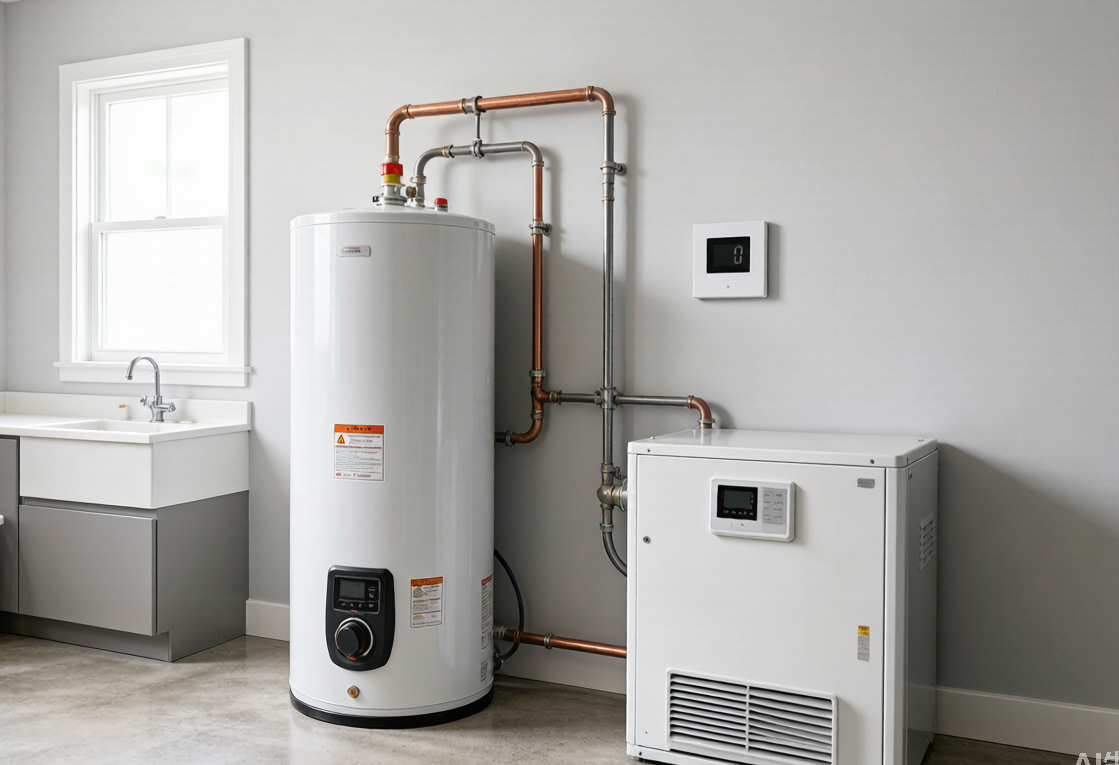
Water heater closet
Small, enclosed, often unventilated, and frequently the oldest gas appliance in the house. A closet concentrates any escaping gas fast, which is good for detection and bad for everything else.
Place the detector inside the closet if the door is louvred or left ajar. If the closet is sealed, mount it immediately outside the door instead — a sealed closet may hold gas long enough for the sensor inside to alarm while nobody hears it.
Basement
Basements collect what the rest of the house sheds. Propane, being heavier than air, sinks and pools here; natural gas that has migrated down through floor penetrations can linger where there is no airflow.
Basements also concentrate CO from furnaces and water heaters, which is a separate and equally serious threat — covered in Basement CO Alarm: Why Your Basement Needs a Carbon Monoxide Detector.
Attached garage
Not usually a gas-line location, but often where a spare propane cylinder, a generator, or a grill tank is stored — and always where vehicle exhaust enters the house. See Garage Carbon Monoxide Detector for the CO side of this room.
Hallway outside bedrooms
The backstop. This detector is not close to any appliance; its job is to wake you if gas has spread far enough to reach the sleeping area. Mount it in the hallway serving the bedrooms, one per floor.
Mounting height: natural gas vs propane
This is the detail that most placement guides get wrong, and it changes the entire installation.
- Natural gas (methane) is lighter than air. It rises and collects near the ceiling. Mount detectors within about 12 inches of the ceiling, or high on the wall.
- Propane / LPG is heavier than air. It sinks and pools at floor level. Mount detectors within about 12 inches of the floor.
If you are unsure which fuel you have: a utility bill and a pipe from the street means natural gas; a tank on the property means propane. If your home uses both — a natural gas range with a propane fireplace, for example — place detectors at both heights in the relevant rooms, or use a unit rated for both fuel types and follow the manufacturer's placement guidance for the heavier gas.
Propane-specific placement in mobile applications is covered further in RV Propane Detector.
Where not to install a detector
Placement errors cause false alarms and sensor failure far more often than defective hardware:
- Directly above the stove or in the steam path of a kettle or dishwasher. Humidity and cooking aerosols degrade sensors and trigger nuisance alarms.
- Within 3 feet of a bathroom door, humidifier, or laundry vent. Same reason.
- Beside a window, exterior door, or HVAC supply register. Moving air dilutes the gas before it reaches the sensor and delays detection.
- In a dead-air corner — the last 4 inches where wall meets ceiling — where air circulation is poor.
- In unconditioned space outside the unit's rated temperature range, such as an uninsulated attic or an unheated shed.
- Behind furniture, curtains, or inside a cabinet. A detector needs open airflow and needs to be audible.
Signs of a leak you can catch before the detector does
A detector is the reliable layer, but human senses catch some leaks first:
- Rotten-egg smell. Natural gas and propane are odorless; utilities add mercaptan specifically so leaks are noticeable. Trust this smell immediately.
- Hissing or whistling near a pipe, meter, or appliance connection.
- Dead or discolored vegetation in a line over a buried service line, with no other explanation.
- Bubbles in standing water near the meter or a buried line after rain.
- A gas bill that climbs with no change in usage.
- Physical symptoms that improve when you leave the house — headache, dizziness, nausea, fatigue. These overlap with CO poisoning symptoms and should never be dismissed.
One important limitation: a sense of smell is not a safety system. Odorant can fade in older lines, olfactory fatigue sets in within minutes of continuous exposure, and roughly one person in fifty cannot detect mercaptan at all. This is precisely the gap a detector fills.
What to do the moment the alarm sounds
Rehearse this. In the actual moment, people go looking for the leak, which is the wrong instinct.
- Do not touch any electrical switch, appliance, or garage door opener. A switch arc is an ignition source. This includes turning lights off as well as on.
- Do not use a phone inside the building. Take it with you and call outside.
- Open doors on your way out if it costs you no time. Do not go around opening every window.
- Get everyone and every pet out of the building.
- Shut off the gas at the main valve if — and only if — the valve is outside and you can reach it safely. Never re-enter to reach an indoor valve.
- Call the gas utility's emergency line from a safe distance, then the fire department. Both respond to residential gas calls, and the utility call is free.
- Do not re-enter until the utility or fire department clears the building. Not to grab a laptop, not to check the detector.
- Have the leak repaired by a licensed technician before restoring service. Then test every detector in the house.
If anyone shows symptoms of exposure — confusion, loss of coordination, unconsciousness — treat it as a medical emergency and say so on the call.
Retrofitting an older home
Homes built before roughly 1990 present three specific issues:
- Aging flex connectors. Uncoated brass connectors manufactured before the mid-1980s are known to fail. If you find one, have it replaced regardless of appearance.
- Fewer outlets in the right places. A plug-in detector is only useful where there is an outlet at the correct height. Battery-operated or magnet-mounted units solve the placement problem where wiring does not cooperate.
- Renters cannot modify walls. A unit that mounts magnetically or sits on a shelf, with no drilling, is often the only viable option in a rental — and it moves with you.
What to look for in the detector itself
Placement only pays off if the hardware holds up:
- Combustible gas sensitivity measured against the LEL (lower explosive limit), so it alarms well before the mixture becomes flammable.
- Electrochemical CO sensing as a separate channel — gas and CO are different threats requiring different sensors.
- A live digital readout, so you can see a slow rise before it reaches the alarm threshold rather than only hearing a binary beep.
- Plug-in power with battery backup. Gas incidents and power outages correlate; a mains-only unit is offline exactly when a generator is running.
- Wide voltage input (AC 100–240V) if you move between regions or properties.
- Tested to recognized safety standards. The VASAIKO HD16 is tested to UL 2034, UL 1484 and UL 217 standards, is CE & FCC Certified and RoHS Compliant, and has been tested by a CNAS-accredited laboratory.
The HD16 combines combustible gas and CO detection with smoke sensing, a digital display, and temperature and humidity readings in one unit — which matters for whole-home coverage, because buying three or four single-function devices per property gets expensive and cluttered fast. Details are on the HD16 safety detector page.
Frequently asked questions
Can one detector cover a whole house?
No. Gas concentration is highly localized, and interior walls and closed doors slow dispersion dramatically. Plan for one unit per appliance zone plus one per sleeping level.
Do gas leak detectors expire?
Yes. Electrochemical and catalytic sensors degrade over time. Most units carry a service life of 5–10 years, marked on the housing. Replace the whole unit at end of life rather than assuming a silent detector is a working one.
How often should I test them?
Press the test button monthly — that verifies the alarm circuit and speaker, not the sensor. Check the manufacturer's guidance for sensor verification, and confirm the display shows a live reading rather than a frozen value.
Will a gas detector alarm on cooking fumes or aerosols?
A properly placed unit should not alarm on normal cooking. Hairspray, solvent-based cleaners, paint thinner, and alcohol vapor can register on a combustible-gas sensor at close range, which is one reason not to mount a detector inside a cleaning cupboard or immediately beside a bathroom vanity.
Is a smoke alarm enough?
No. A smoke alarm responds to particulates from combustion. A gas leak produces no smoke, and carbon monoxide is invisible and particle-free. They are three distinct sensing technologies for three distinct threats.
Where does the detector go in a single-story home with a gas furnace in the attic?
Attics usually fall outside a detector's rated temperature and humidity range. Place the unit in the hallway below the attic access instead, at ceiling height for natural gas, and have the attic appliance inspected annually.
Do I need one if my house is all-electric?
For gas, no. For carbon monoxide, possibly yes — an attached garage, a wood stove, a fireplace, or a portable generator all produce CO in an otherwise all-electric home.
The bottom line
A home gas leak detector is a coverage decision, not a product decision. Trace the fuel line, count the appliance zones, mount high for natural gas and low for propane, keep sensors away from steam and drafts, and rehearse the response before you need it.
The households that get hurt are almost never the ones with no detector at all. They are the ones with a single detector in the wrong room, at the wrong height, that expired three years ago.
Explore the VASAIKO HD16 6-in-1 carbon monoxide monitor — combustible gas, carbon monoxide, and smoke detection with a live digital display, temperature and humidity readings, magnetic mounting, and battery backup.