
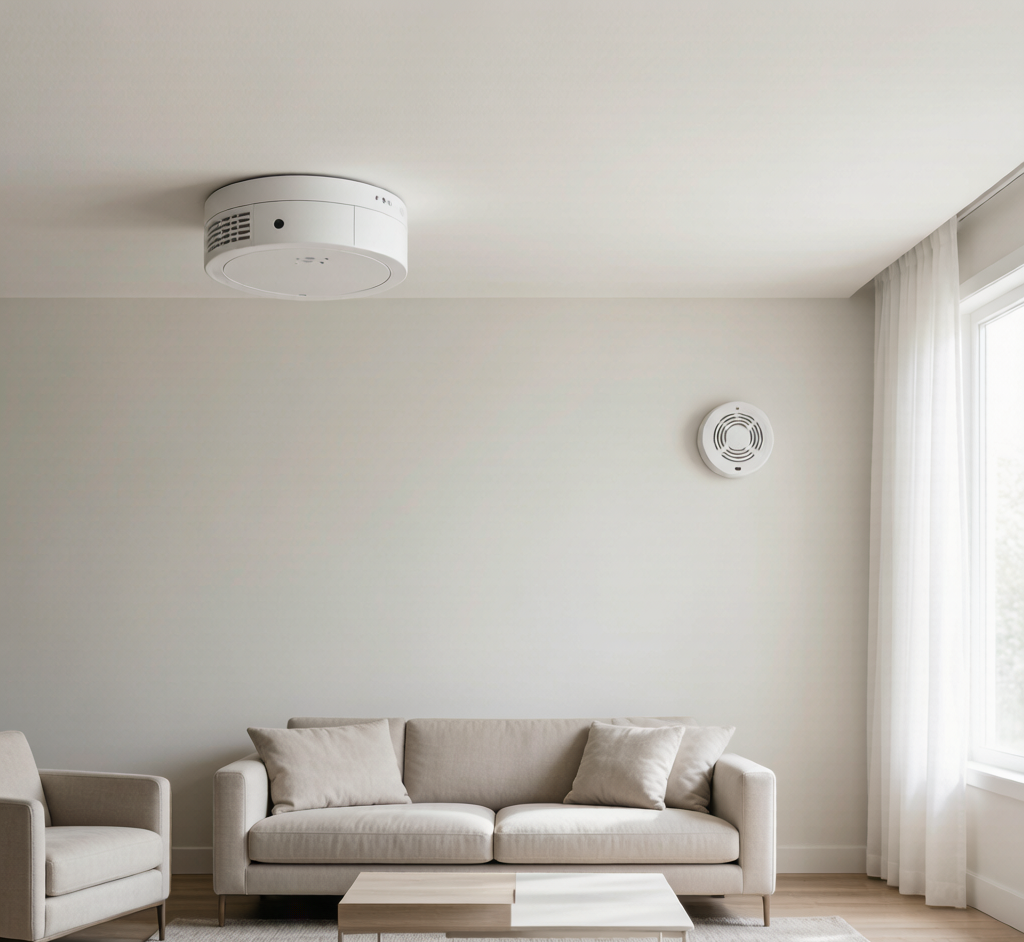
Walk down the detector aisle and you will see two devices that look almost interchangeable — a smoke detector and a carbon monoxide detector. They are not. They watch for two completely different threats, and a home that has one but not the other has a real gap in protection.
This guide explains what each device actually senses, why neither can do the other's job, how they compare side by side, and how a single combination unit can cover both without doubling the hardware on your ceiling.
They protect against two different threats
A smoke detector responds to the physical particles of combustion — the visible and invisible smoke a fire produces in its early, smoldering stage. Its job is to warn you that something is burning before flames spread.
A carbon monoxide detector responds to carbon monoxide (CO): a colorless, odorless, tasteless gas created whenever fuel burns incompletely. A furnace, water heater, gas stove, fireplace, generator, or idling car can all produce it. CO displaces oxygen in the blood, and at high enough levels it is fatal within hours — often while people sleep.
The simplest way to keep them straight:
- Smoke detector = "something is on fire."
- CO detector = "the air itself is poisoned."
One detects a product of burning. The other detects a poison in the air. They share a wall and a similar shape, but they are solving two separate problems.
Why one cannot replace the other
This is the part people get wrong. A smoke detector does not respond to carbon monoxide, and a CO detector does not respond to smoke. Each failure mode slips past the other device:
- A slow, smoldering fire in a couch or mattress may produce little to no CO in its early hours. A CO detector will sit silent while smoke builds. Only the smoke detector catches it.
- A CO leak from a cracked heat exchanger or a blocked flue produces no smoke at all. A smoke detector will never sound. Only the CO detector catches it.
- In a garage with a running car, CO seeps through shared walls with no fire and no smoke. A smoke detector is useless here; this is exactly the garage CO scenario covered in Garage Carbon Monoxide Detector.
Neither device is "better." They are complementary. A home with only a smoke detector is blind to the silent gas; a home with only a CO detector is blind to a smoldering fire.
Smoke detector vs carbon monoxide detector, side by side
| Smoke detector | Carbon monoxide detector | |
|---|---|---|
| What it senses | Combustion particles (smoke) | Carbon monoxide gas (CO) |
| Sensor type | Photoelectric or ionization chamber | Electrochemical cell |
| Triggers on | Visible/smoke particles in the air | CO concentration over time |
| Standard | UL 217 | UL 2034 |
| Typical placement | Ceiling, center of room or hallway; outside bedrooms | Wall, ear-level, outside sleeping areas; near fuel-burning appliances |
| Power | Hardwired, 10-year sealed, or battery | Plug-in, hardwired, or battery |
| Detects gas leaks? | No | No (CO only, not raw natural gas/propane) |
| Detects fire? | Yes | No |
Notice the last two rows. Neither a smoke detector nor a basic CO detector senses a raw natural gas or propane leak — that takes a combustible-gas sensor. If you want all three threats covered, you need a unit built for it, not two off-the-shelf singles stacked together.
Single-function units vs a combination detector
The traditional answer is to mount both: a smoke alarm in each sleeping area and a CO alarm outside each bedroom, plus one per level. That works, but it multiplies devices, batteries, nuisance chirps, and ceiling clutter — and it still leaves gas leaks uncovered.
A combination smoke and CO detector puts both sensors in one housing. Step up to a 6-in-1 unit like the VASAIKO HD16 and you also get combustible-gas sensing, a live digital readout, temperature and humidity, and placement flexibility:
- Smoke + CO + combustible gas in one device — covers fire, the invisible poison, *and* a raw gas leak.
- Live digital display showing PPM, temperature, and humidity, so you see a creeping low-level CO reading a threshold-only alarm would never mention. The PPM thresholds behind that display are laid out in Safe CO PPM Levels Chart.
- Plug-in power with battery backup, so it stays awake through the exact outages when people fire up generators and CO risk spikes.
- Magnetic mounting for placement where drilling is not an option — RVs, cabins, and rental walls included (the RV angle is covered in RV Carbon Monoxide Detector).
The HD16 is tested to UL 2034, UL 1484 and UL 217 standards, is CE & FCC Certified and RoHS Compliant, and has been tested by a CNAS-accredited laboratory. It is built around the idea that whole-home coverage should not mean buying four separate gadgets per property. Full specifications are on the HD16 safety detector page.
Where to place each
Placement rules differ because the threats move differently through a house.
Smoke detectors
- Mount on the ceiling, centered in a room or in hallways, because smoke rises.
- Put one outside every sleeping area and on every level.
- Keep them at least 10 feet from the cooking surface — kitchen steam and grease aerosol cause most nuisance alarms.
CO detectors
- Mount on a wall at roughly ear level, outside bedrooms, because CO mixes with air and does not reliably rise.
- Cover every sleeping level and any room with a fuel-burning appliance.
- Avoid dead-air corners (top inside corners of ceilings) where CO can stall.
Combination units simplify this: one device placed per the CO rule still gives you smoke coverage for that zone, and a 6-in-1 with gas sensing also watches the appliance nearby. For a room-by-room gas-placement plan, see Home Gas Leak Detector: A Room-by-Room Guide.
What to do when each alarm sounds
The response is different, and mixing them up wastes critical minutes.
Smoke alarm
- Treat it as fire until proven otherwise.
- Get everyone out, staying low if there is smoke.
- Call emergency services from outside.
- Do not re-enter.
CO alarm
- Get everyone (and pets) into fresh air immediately — open doors on the way out.
- Do not try to find the source yourself.
- Call emergency services or the fire department; CO poisoning needs medical evaluation even without symptoms.
- Have fuel-burning appliances inspected before reoccupying.
If you are not sure which alarm is sounding, the beep pattern tells the story — a steady three-beep smoke cadence versus a four-beep CO cadence, versus the single chirp of a low battery. The full pattern reference is in Carbon Monoxide Detector Beeping.
What a good detector should give you
When you shop, the spec that matters most is verifiable certification. Look for testing to UL 2034 for CO, UL 1484 for gas, and UL 217 for smoke. Beware vendors who imply a full UL *listing* without a verifiable file number; the honest claim for a tested unit is "tested to UL 2034 standards." Beyond certification:
- Backup that survives an outage. CO risk peaks when power fails and people reach for generators or gas heaters. Plug-in with a built-in backup battery matters more than most buyers realize.
- A live readout. A digital PPM display catches developing faults and chronic low-level exposure long before a threshold-only alarm would ever sound.
- Placement flexibility. Magnetic mounting lets you site the unit where the risk actually is — including spots you cannot drill.
Frequently asked questions
Can a smoke detector detect carbon monoxide?
No. A smoke detector senses combustion particles; it has no sensor for CO gas. A home relying only on smoke alarms is completely unprotected against carbon monoxide.
Can a carbon monoxide detector detect smoke or a gas leak?
A CO detector senses only carbon monoxide. It does not respond to smoke and, by itself, does not sense a raw natural gas or propane leak. For gas leaks you need a combustible-gas sensor (included in a 6-in-1 unit like the HD16).
Do I need both if I have no gas appliances?
Yes for CO. Even all-electric homes can be exposed to CO from an attached garage with a running car, a neighbor's shared wall, or a charcoal grill used too close to a window. Smoke coverage is still required regardless of fuel type.
Is a smoke and CO combination detector as reliable as two separate ones?
A properly tested combination unit meets the same UL 217 (smoke) and UL 2034 (CO) performance criteria as separate devices. The advantage is consolidated coverage, fewer batteries, and — in a 6-in-1 — added gas sensing the singles cannot provide.
Where should a combination smoke and CO detector go?
Follow the CO placement rule: on a wall at roughly ear level, outside sleeping areas, on every level. That position still gives you smoke coverage for the zone, since smoke will reach it as it spreads.
The bottom line
A smoke detector and a carbon monoxide detector are not the same device, and a home missing either one has a real hole in its safety net. Smoke catches fire; CO catches the invisible poison — and a raw gas leak slips past both unless you have a gas sensor too.
The cleanest way to close all three gaps is one combination unit placed where the risk lives, with backup power and a readout you can actually read.
Explore the VASAIKO HD16 6-in-1 carbon monoxide monitor — smoke, carbon monoxide, and combustible-gas detection with a live digital PPM display, temperature and humidity readings, magnetic mounting, and battery backup.