
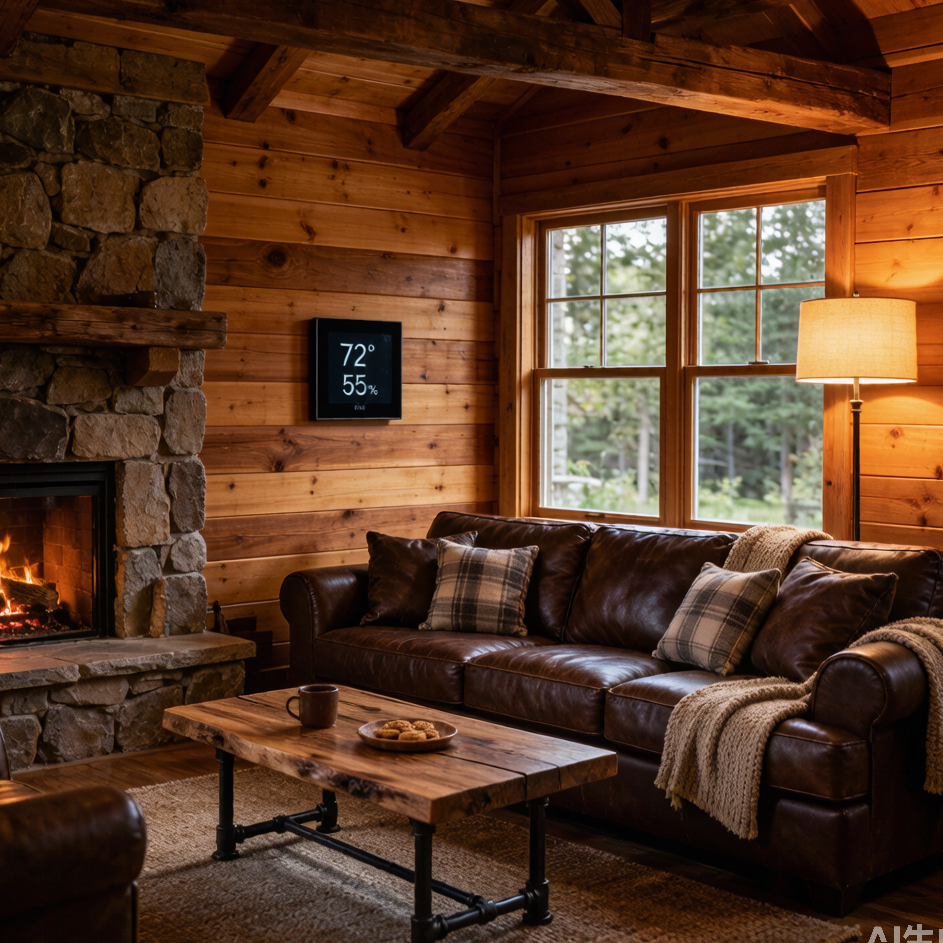
A cabin is supposed to be the place you unwind — wood stove glowing, fireplace crackling, generator humming through a power outage. But every one of those comforts is also a carbon monoxide source. A dedicated CO alarm for cabin use is one of the most overlooked safety steps for remote and seasonal homes, and the risk profile is different from a suburban house in ways most owners never consider.
Why cabins are a hidden CO risk
Carbon monoxide is produced any time fuel burns incompletely — wood, propane, gasoline, kerosene. Cabins stack several of the highest-risk sources in one small, often poorly ventilated space:
- Wood stoves and fireplaces. A cabin's primary heat is usually a wood stove or open fireplace. A cracked firebox, creosote buildup, or a flue blocked by a bird's nest can push CO right back into the room instead of up the chimney.
- Propane and gas heaters. Wall-mounted propane heaters, gas lamps, and range stoves are common in off-grid cabins where there is no electric heat.
- Generators. During an outage — which cabins see far more often than city homes — a portable generator running nearby is a well-known CO culprit if its exhaust drifts toward a window or door.
- Vehicle exhaust. If you park an ATV, snowmobile, or truck in an attached shed or carport, idling fumes can wander into living space.
A carbon monoxide detector for cabin placement catches these leaks where they start, not after the gas has already filled the room you are sleeping in.
Remote and seasonal make it worse
Two facts about cabins raise the stakes compared to a primary residence:
- They sit empty for long stretches. A weekend or seasonal cabin can go weeks without a visit. CO sources — a slow flue leak, a spider nest in a vent, a piloted appliance — develop and build with no one there to notice. A detector that logs or shows live air quality tells you something was wrong the moment you walk back in.
- They are colder and harsher. Freezing nights, humidity swings, and condensation are normal in a cabin. That environment stresses both the building and the appliances inside it, and it is exactly when combustion equipment misbehaves.
This is why a cabin CO safety plan should treat the detector as essential infrastructure, not an optional extra.
Wood stove CO safety
The wood stove deserves its own note, because it is the single most common cabin CO source:
- Burn only seasoned, dry wood. Green or wet wood smolders, produces more smoke, and raises CO far more than a hot, clean fire.
- Keep the flue and chimney inspected and cleaned every season. Creosote and blockages are the top causes of CO spilling into the room.
- Never close off the stove's air supply to "bank" a fire for the night in a way that starves it of oxygen — that increases incomplete combustion and CO.
- Install the detector in the same room as the stove, in the breathing zone, but not so close that heat or dust fouls the sensor.
Good wood stove CO safety habits plus a working alarm are the combination that actually prevents poisoning.
What to look for in a cabin CO alarm
Cabin conditions — cold, damp, off-grid, wood walls — change what "the right detector" means:
- Temperature & humidity readout. In a cabin you leave for weeks, a sensor that shows live temperature and humidity is genuinely useful: a sudden warm-and-humid reading can flag a frozen-pipe burst or a leak while you are away. (Note: the temp/humidity display is an added convenience reading, not part of the CO safety certification.)
- Battery backup. Cabins lose power often, and that is usually when the generator — another CO source — is running. Protection must survive the outage.
- Flexible mounting for wood walls. You do not want to drill into heavy logs. A compact detector with a magnetic mount or a simple screw plate installs cleanly on a beam or wall without damaging the structure.
- Combined gas + CO + smoke sensing. Many cabins also store propane tanks, gasoline for tools, and lamp oil. A 6-in-1 unit that senses natural gas and propane leaks *and* smoke *and* CO covers more of the real cabin risks in one device.
- Standards. Look for devices tested to UL 2034 for CO, UL 1484 for combustible gas, and UL 217 for smoke, and that are CE & FCC certified for the markets they ship to.
Where to install a carbon monoxide detector in a cabin
Placement matters as much as the device:
- Put one in the main living space where the wood stove or fireplace is, in the breathing zone roughly 5 feet above the floor.
- Add one near sleeping areas — lofts and bedrooms — so an overnight leak wakes you.
- If the cabin has an attached shed, carport, or generator alcove, place a detector on the wall between that space and the living area.
- Keep detectors away from direct stove exhaust, dead-air corners behind doors, and spots where condensation pools.
Testing and maintenance
A detector only protects you if it works, and cabins are easy to neglect between visits:
- Test monthly with the test button, including the first trip of the season.
- Replace batteries before the cold season, and replace the whole unit every 7–10 years per the manufacturer.
- Never ignore chirps or end-of-life warnings — they mean the device needs attention now, not next spring.
Related reading
- The Complete RV Carbon Monoxide Detector Guide (2026)
- Basement CO Alarm: Why Your Basement Needs a Carbon Monoxide Detector (2026)
- Why Your Carbon Monoxide Detector Should Also Show Temperature & Humidity
Watch your cabin while you are away
The VASAIKO HD16 is a 6-in-1 smart detector that combines carbon monoxide, natural gas, propane, and smoke sensing with a live temperature and humidity display, a digital readout, a magnetic mount, and battery backup. It is built for exactly the cabin scenario — wood walls, cold nights, power outages, and long empty stretches — so your retreat stays safe whether you are there or not. See how it fits your setup on our HD16 safety detector page.
Living smaller than a cabin? Tiny houses concentrate CO faster than almost any other dwelling type, because the same appliance exhaust has roughly one tenth the air to dilute into. See our tiny house carbon monoxide detector guide for placement, make-up air, and diesel heater specifics.