
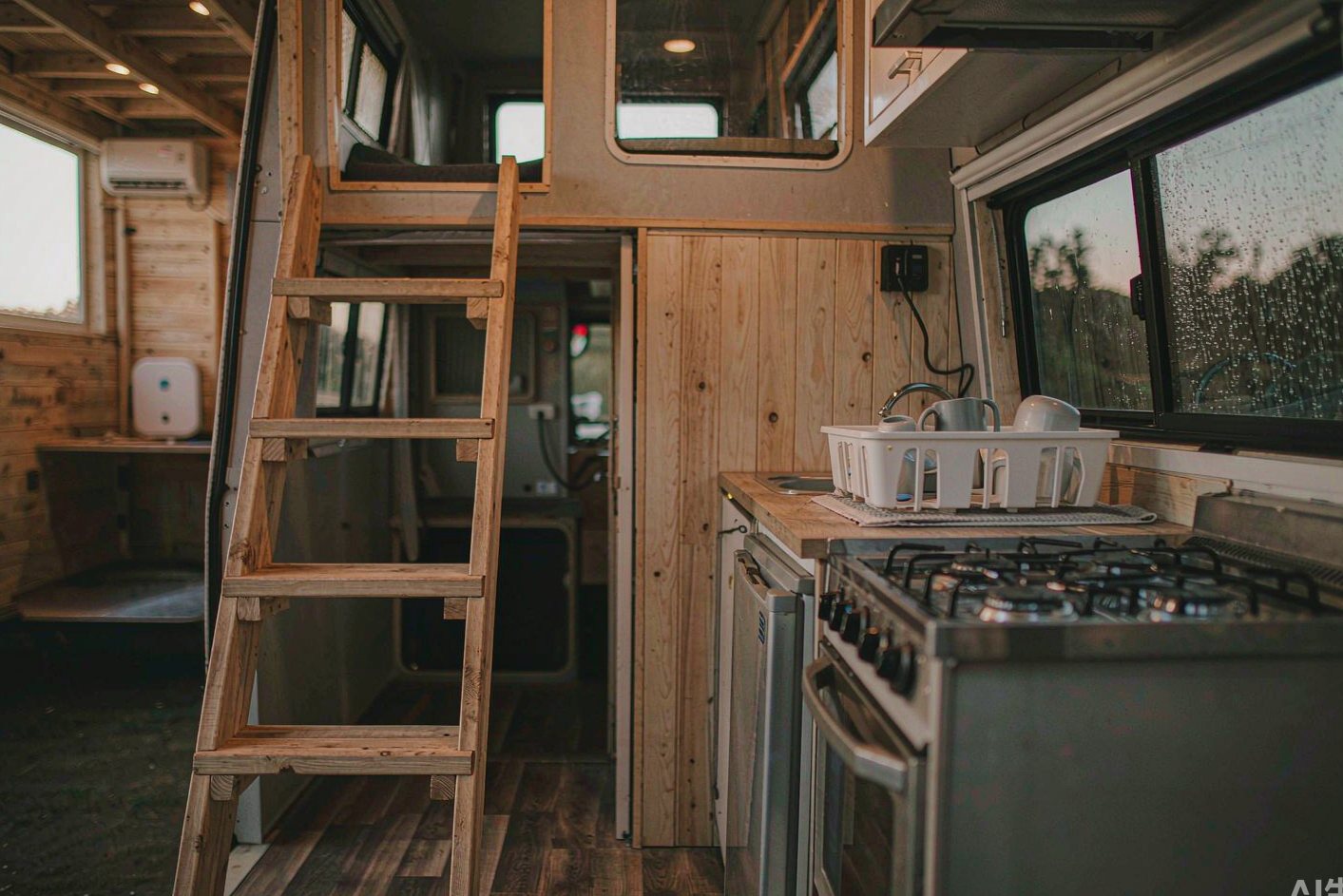
A tiny house is not a small version of a house. When it comes to carbon monoxide, it behaves more like a boat or a van: the same amount of CO that would be a slow, diluted annoyance in a 2,000 sq ft home can reach a serious concentration in a 200 sq ft tiny house in a fraction of the time. Everything that makes small living attractive — tight sealing, heavy insulation, efficient combustion appliances packed into a few square feet — also removes the margin for error.
This guide covers why tiny houses are a distinct category, which appliances actually generate the CO, what the relevant codes require, where a detector belongs when your bedroom is a loft four feet from the cooktop, and how to read the low numbers a standard alarm is designed to keep silent.
The physics problem: you have almost no air
Volume is the first thing to understand, because it drives everything else.
A 2,000 sq ft house with 8 ft ceilings holds roughly 16,000 cubic feet of air. A 200 sq ft tiny house with the same ceiling height holds about 1,600 — one tenth as much. If an appliance produces the same small amount of CO in both spaces, the tiny house reaches roughly ten times the concentration.
This is why "it's just a small stove" or "the oven is only on for ten minutes" does not hold up in a tiny house. Ten minutes that would register as a barely measurable blip in a large kitchen can produce a reading you can actually see in a small one.
Two more structural factors compound it:
- Tight sealing. Spray foam, house wrap, and RV-grade windows mean very little natural infiltration. A leaky old house dilutes its own mistakes. A well-built tiny house does not.
- Appliance density. A tiny house often runs a propane cooktop, a tankless propane water heater, a wood stove, and a diesel parking heater inside the same 200 square feet. That is four combustion sources in a space smaller than most living rooms.
For context on what different ppm levels actually mean in practice, see our breakdown in Safe CO ppm Levels: What the Numbers Mean.
Where the CO actually comes from in a tiny house
1. The propane cooktop and oven
The most common source, because it runs every day. A properly burning propane flame produces very little CO. A flame with a lazy yellow tip, a partially blocked burner, or a pot that smothers the flame produces noticeably more. Normal cooking typically produces single-digit to low-tens ppm near the burner, which is exactly the band a standard alarm is not permitted to respond to.
The genuinely dangerous practice is using the oven as a heater. It is common in small spaces in cold weather, and it is one of the fastest ways to fill a tiny house with CO. Never do it.
2. Tankless propane water heaters
On-demand heaters draw a large, sudden volume of combustion air when they fire. In a tight tiny house, that air has to come from somewhere. If the unit is not sealed-combustion (drawing air from outside through a dedicated duct), it pulls from the room — and if the room is under negative pressure from an exhaust fan, the flue can reverse. That is a backdraft, and it dumps combustion products straight into your living space.
3. Wood stoves
Small wood stoves are extremely popular in tiny houses and are a real CO source when they smolder. A stove choked down overnight for slow heat burns incompletely. So does wet or unseasoned wood. The risk peaks in the hours when everyone is asleep in the loft directly above.
4. Diesel parking heaters
The cheap diesel "parking heaters" widely used in tiny houses, vans, and skoolies are probably the single least understood CO risk in small-space living. They are designed for vehicle installation with specific exhaust routing and a sealed combustion air path. Installed in a tiny house by an owner following a video, they frequently end up with:
- exhaust routed too close to a window, door, or fresh-air intake
- combustion air drawn from inside the living space instead of outside
- joints that leak under the positive pressure of the exhaust run
A diesel heater that leaks does not always produce the sharp, obvious smell people expect. It can raise indoor CO steadily while the space feels comfortably warm.
If you run one, treat it like a marine installation: sealed combustion, exhaust well clear of any opening, and a detector mounted in the breathing zone.
5. Generators and portable equipment
Anything with an engine belongs outside, far away, with the exhaust pointed away from the house. This sounds obvious and is violated constantly. Our generator guide covers the distance rules and why "just outside the door" is not outside: Generator Carbon Monoxide Safety.
What the codes actually require
Tiny houses sit in an awkward regulatory space, and what applies depends on how your house is classified.
IRC Appendix Q. The International Residential Code's Appendix Q applies to dwellings of 400 sq ft or less and sets minimum requirements including ceiling height, loft access, and emergency egress. Where adopted, it requires smoke alarms and carbon monoxide alarms in locations consistent with the rest of the IRC — which means outside each sleeping area and on each level.
RVIA certification. If your tiny house is certified as a recreational vehicle rather than a dwelling, a different set of requirements applies, and many states treat it as a vehicle for code purposes. RV-standard CO alarms are common in this case.
Local adoption. This is the part that actually matters. Appendix Q is a model code; it only has force where your jurisdiction has adopted it, and adoption is inconsistent. Some counties treat tiny houses as ADUs, some as RVs, some have no category at all.
Two practical conclusions hold regardless of classification:
- A code-required CO alarm is the baseline device. It is the one that sounds at the thresholds the standard mandates. Nothing replaces it.
- A CO alarm is deliberately quiet at low levels. That is not a defect — it is what the device is for. An alarm is engineered to sound at concentrations that are dangerous, and to tolerate small transient readings so that everyday cooking does not desensitise the household. In a tiny house, where concentrations can climb quickly, that leaves a band of low readings a threshold alarm will not show you.
That gap between "the alarm is required to stay quiet" and "I want to know what the air is doing" is the entire reason a supplemental monitor with a live display exists. See the HD16 and add the missing layer Our detailed explainer covers the thresholds: UL 2034 Explained: What the Standard Actually Requires.
Placement when your bedroom is a loft
Tiny houses break the standard placement advice in two ways: the sleeping area is often directly above or adjacent to the main combustion source, and the whole dwelling is small enough that "central location" is nearly meaningless.
Do:
- Mount the alarm so it is audible from the loft with the door closed. In a tiny house this is usually achievable from a single location — verify by having someone sound the test button while you lie in the loft.
- Keep it in the breathing zone. CO mixes with air; at typical ceiling heights in a tiny house the difference between knee height and ceiling height is small, so the exact height matters far less than in a cathedral-ceilinged house. Our full analysis is here: CO Detector Placement Height: What Actually Matters.
- Give the cooktop some distance — several feet at minimum — so normal cooking does not produce nuisance alarms.
Don't:
- Don't mount it directly above the stove or the water heater.
- Don't bury it inside a cabinet, behind a curtain, or in a dead-air corner behind the ladder.
- Don't put it in the dead space right at the peak of a vaulted roof if nobody breathes there.
- Don't rely on a single device in a space that also has a separate sleeping structure, such as a detached sleeping porch or a second tiny unit.
The most common placement mistake in small spaces is not height — it is putting the detector where the air does not move.
Make-up air: the thing most tiny house owners miss
Every cubic foot of air your range hood, bath fan, or clothes dryer pushes outside has to be replaced by air coming back in. In a leaky house, that air seeps in through a thousand small gaps. In a tight tiny house, it comes in through whatever opening is available — and if that opening is the flue of your water heater or wood stove, the flow reverses.
Signs you have a negative pressure problem:
- the wood stove smells smoky when the bath fan is running
- the range hood is powerful and the house has no dedicated fresh-air intake
- you feel a noticeable draft at the stove flue when the fan is on
- a candle or incense flame near the stove leans toward the appliance
The fix is unglamorous and effective: crack a window an inch when combustion appliances are running, or install a proper combustion air intake. It costs almost nothing and removes an entire class of backdraft risk.
Humidity, condensation, and what else is in the air
Tiny houses have a humidity problem by construction: one or two people breathing, cooking, and showering in 200 square feet produces a lot of water vapor, and tight sealing keeps it in. Condensation on windows is normal; condensation inside walls is not.
A combined monitor that reports temperature and humidity alongside CO is genuinely useful here — not because humidity is a gas hazard, but because it tells you when your ventilation strategy is failing, which is the same condition that lets CO accumulate. We cover the trade-offs here: CO Detector with Temperature and Humidity.
It also helps with nuisance alarms. High humidity and cooking aerosols are behind a lot of the "why is it beeping" confusion in small spaces: Why CO Detectors Cause False Alarms.
Small spaces reward information over guesswork. A live readout turns "I think it's fine" into a number you can watch: See the HD16 and add the missing layer
Reading the numbers in a small space
This is where a display earns its place. In a tiny house, the useful information is not "is it alarming" — it is "is this number trending up."
A realistic pattern on a normal evening:
| Activity | Typical reading near the source | What it means |
|---|---|---|
| Baseline, nothing running | 0 ppm | Normal. A display showing 0 is the correct reading. |
| Propane burner lit, pot on | 5–15 ppm | Normal combustion. Ventilate and it clears. |
| Oven running for a while | 10–30 ppm | Below the alarm's response thresholds — ventilate and re-check. |
| Wood stove smoldering | 20–60 ppm | Trend matters more than the peak. Check the air supply. |
| Diesel heater with a leak | climbing steadily | Shut it down, ventilate, and get the exhaust inspected. |
The column that matters is the trend. A reading that sits at 12 ppm and holds is very different from a reading that was 6 ppm an hour ago and is now 18.
Ephemeral, low-level readings are exactly what alarms are designed to ignore, and exactly what you want to see. Our HD16 monitor is built for that layer — a live digital readout that updates every two seconds, with a visual band that changes well before any alarm threshold is reached. It is a supplemental monitor, not a replacement for the alarm your code requires.
See the HD16 and add the missing layer
If you also run propane appliances, a combined CO and combustible gas unit covers more of the failure modes in a small space. The buying trade-offs are here: Combination CO and Gas Detector Buying Guide.
A practical tiny house checklist
- One code-required CO alarm, mounted to be audible from the loft. Non-negotiable, code-required.
- One display monitor in the main living zone, where you will actually look at it.
- Combustion air. Crack a window or install an intake when anything burns.
- Exhaust separation. Diesel heater and generator exhaust must exit well clear of windows, doors, and intakes.
- Never heat with the oven. Not for five minutes. Not overnight.
- Seasoned wood only, and don't choke the stove down for slow overnight burns.
- Test monthly, and replace units on the manufacturer's schedule — electrochemical sensors have a finite life, typically around five years. Details: How Long CO Detectors Last.
- Know the difference between the alarm and the monitor. One is required and loud. The other shows you the number.
Ready to add the missing layer? See the HD16 and add the missing layer
Small-space living is a genuinely different environment, and the RV and off-grid communities have worked out most of these lessons already. If your build is closer to a vehicle than a cabin, two more guides are worth reading: RV Carbon Monoxide Detectors and CO Alarms for Cabins.
FAQ
Do tiny houses legally require a carbon monoxide detector?
Where the IRC Appendix Q or the RV code applies, yes — generally outside each sleeping area and on each level. Adoption varies by jurisdiction, and some counties classify tiny houses as ADUs or RVs, which changes the standard that applies. Check with your local building department, and install one regardless.
Is one detector enough in a tiny house?
For an alarm, usually — the space is small enough that one properly placed unit is audible everywhere, including the loft. For a monitor, one is enough as long as it sits in the air you actually breathe rather than in a dead corner.
Where should it go if my loft is directly above the stove?
Not directly above the stove. Mount it a few feet away on the wall or ceiling of the main volume, high enough to be in open air, positioned so the test tone is clearly audible from the loft with your head on the pillow.
Can I use my oven to heat the tiny house?
No. This is one of the fastest ways to produce dangerous CO in a small space, and it also produces large amounts of water vapor. Use a heater designed for the purpose.
Are diesel parking heaters safe indoors?
The heater itself is fine; the installation usually is not. They require sealed combustion air from outside and exhaust routed clear of every opening. Poor DIY installations are a recurring source of CO incidents in tiny houses and vans.
Why does my detector show a number but never alarm?
Because an alarm is built to answer a different question. It is designed to sound at the concentrations that are dangerous and to stay quiet below them — that is what keeps it trustworthy. A low reading is still real information; it is simply information the alarm was never designed to report, which is why a separate display is useful. What the standard actually requires is covered in UL 2034 Explained.
Does a tiny house need a gas detector too?
If you run propane — cooktop, water heater, fridge, or furnace — a combustible gas detector adds a layer the CO alarm cannot provide. It responds to leaking unburned gas, which contains no CO at all until something lights it. See Do You Need a Gas Detector in Your House?.
How often should I replace the unit?
Follow the manufacturer's stated service life, commonly around five years for the electrochemical CO sensor, and replace at end of life even if it still powers on. Sensor sensitivity drifts downward over time — it does not fail loudly.
*VASAIKO builds supplemental CO monitors with live digital readouts — the layer that shows you what a standard alarm is required to keep silent. They do not replace the CO alarm your code requires.*