
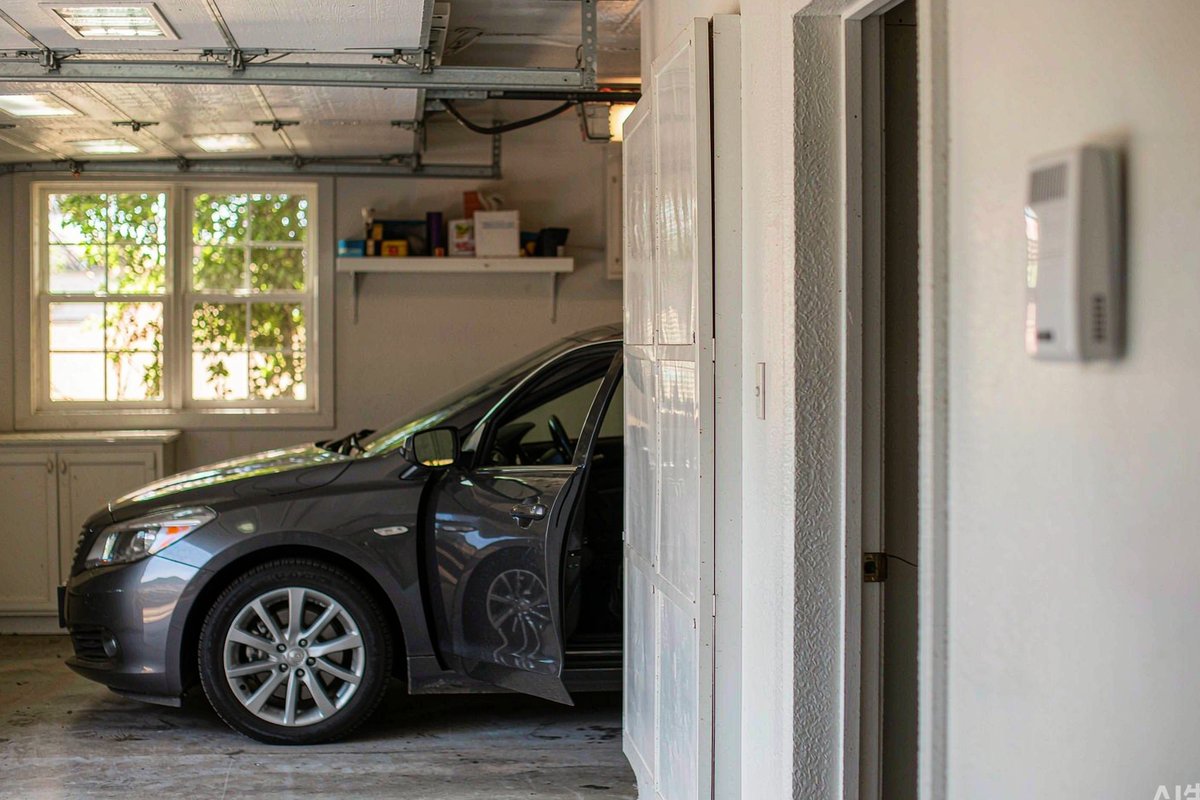
A detached garage is a separate building. An attached garage is part of the house — same foundation, shared walls, a door that opens directly into your kitchen, hallway, or mudroom, and usually a ceiling that carries ductwork, plumbing chases, and electrical penetrations into the living space above.
That difference matters more than most homeowners realize. Carbon monoxide does not respect the door between the garage and the house. It moves through that boundary by pressure, by diffusion, and through the dozens of small gaps that exist in every shared wall — and it does it whether or not the car is still running.
This guide covers why attached garages behave differently from detached ones, the specific paths exhaust takes into your living space, what a cold start does to CO output, where an alarm actually belongs, and why a garage is a harsher environment for a detector than a hallway.
Why an attached garage is different from a detached one
Three structural facts separate the two cases:
Shared surfaces. An attached garage shares at least one wall with conditioned living space. In most American homes built after 1970, it also shares a ceiling with a bedroom, bonus room, or the main floor's duct chase. Every penetration in those surfaces — electrical boxes, plumbing stacks, HVAC returns, recessed lights, dryer vents — is a potential air path.
A direct door. The door from the garage into the house is not an exterior door. It is typically hollow-core or lightly insulated, weather-stripped poorly, and often left standing open while groceries are carried in. Even closed, an undercut of half an inch at the bottom is a continuous opening.
A pressure connection. When the house runs slightly negative relative to the garage — a range hood, a bathroom fan, a clothes dryer, a leaky return duct — garage air is pulled toward the living space rather than out the garage door. This is the single most important mechanism, and it is invisible.
A detached garage has none of these. Gas that leaks there mostly vents to the outdoors. Gas that leaks in an attached garage has a short, low-resistance path into bedrooms.
If you have not read our garage carbon monoxide detector guide, it covers the general garage case. This article focuses on the attached configuration specifically, because the placement logic is materially different.
How car exhaust gets from the garage into the house
There are four paths, and they behave differently.
| Path | Mechanism | How much it moves | What reduces it |
|---|---|---|---|
| The connecting door | Bulk air exchange when the door is opened, plus continuous leakage through gaps and undercuts | Fast — peak concentrations within minutes | Self-closing hinge, proper weatherstrip, door sweep, keeping it shut |
| Shared wall penetrations | Pressure-driven flow through electrical boxes, plumbing chases, recessed lights | Slow but constant | Sealing penetrations with fire-rated caulk or foam, air-sealing the shared wall |
| Ductwork or return leaks | A return duct in the garage or a leaky return nearby pulls garage air into the HVAC system and distributes it | Fast and house-wide | Never place a return in a garage; seal and pressure-test ducts |
| Openings above | Unsealed ceiling penetrations, attic access, plumbing stacks into the floor above | Slow, buoyancy-driven in winter | Seal top plates and chases; verify attic hatch gasket |
The door is the obvious one, but the penetrations are the ones that produce chronic low-level exposure, because they operate continuously and nobody notices them.
Here is the part that surprises people: you do not need to leave the car running. A car that has just been driven into the garage and shut off continues to emit CO from a hot engine and a hot catalytic converter for several minutes. The exhaust system is still hot, the engine bay is still hot, and residual fuel vapor is still working through the system. Park, close the garage door, walk inside, and the garage CO concentration climbs anyway.
The cold-start problem
Carbon monoxide output is not constant across a vehicle's operating cycle. It peaks during cold start — the first one to three minutes after a cold engine is started — because the catalytic converter has not reached its light-off temperature (roughly 400–600°F) and is doing almost nothing to oxidize CO into CO₂.
The practical consequences:
- Winter is worse. A cold soak overnight means a longer light-off delay and a higher CO peak. This is why cold-climate garage events cluster in December through February.
- Remote start is the worst case. A remote start in a closed attached garage runs the engine through its entire high-output window with nobody present to notice. This is one of the most commonly documented causes of serious residential CO exposure in the United States.
- Short trips repeat the peak. A car that only ever drives five minutes never fully warms up, so a disproportionate share of its operating time sits in the high-output window.
- An older or failing converter raises the peak. A converter that has degraded, or a vehicle with a misfire or a rich-running fault, produces substantially more CO than a healthy one.
The countermeasure is behavioral, not technological: never start a vehicle inside an attached garage with the garage door closed, and never use remote start in an enclosed space. Open the door first, back out, then start.
If you want the underlying numbers — how concentration and exposure time interact — our safe CO PPM levels chart maps readings to time-to-alarm and symptom thresholds.
Where to put a CO alarm for an attached garage
This is where most people get it wrong, in both directions. Some homeowners put a single alarm inside the garage and consider it handled. Others rely entirely on the alarm in the hallway and assume it will catch a garage event in time.
Both are incomplete. The correct answer is layered, because the two locations answer different questions.
| Location | What it tells you | What it does not do | Notes |
|---|---|---|---|
| Inside the garage | That CO is being produced, and roughly how much | Does not tell you what is happening in the bedrooms | Gives you the earliest warning and the source signal |
| Just inside the connecting door (house side) | That garage air is crossing into the living space | Lags the garage reading | The single most informative location for an attached garage |
| Hallway outside bedrooms | That occupied space is being affected | Latest warning of the three | This is the life-safety layer that wakes people up |
| Inside a bedroom | That the sleeping occupant is exposed | Localized to one room | Useful if doors are normally closed at night |
Two placement rules that are routinely broken:
Do not mount at ceiling peak height. Carbon monoxide is very close to the density of air — it does not reliably rise to the ceiling and pool there the way people assume. It mixes. Follow the manufacturer's stated mounting height rather than folklore. Our CO detector placement height guide goes through the physics and the code language on this.
Do not mount directly above or immediately beside the vehicle's exhaust path. A detector mounted a foot from where a tailpipe discharges will read a short, extreme spike every time the car pulls in, which is noise rather than signal, and it accelerates sensor exposure to the contaminants discussed below.
The garage-to-house door location deserves emphasis. If you only add one device beyond what you already have, put it on the house side of that door, at breathing height, roughly 3 to 6 feet away from the door itself — far enough to avoid the transient spike when the door opens, close enough to catch migration early.
A plug-in unit works well for that spot, because the outlet you need is usually already on that wall. The VASAIKO HD16 6-in-1 monitor is designed for this kind of placement: it shows live CO, combustible gas, smoke, temperature, and humidity on one screen, so a single device at the garage boundary answers several questions at once.
Why garages are hard on detectors
An attached garage is a hostile environment for a gas sensor. Four stressors, all of which shorten useful life or produce false readings:
- Temperature extremes. An unconditioned garage in Minnesota in January and Phoenix in July spans a range no indoor-rated device is intended for. Repeated thermal cycling stresses solder joints and shifts sensor baseline.
- Humidity and condensation. Wet cars, snow melt, and a damp slab push relative humidity high. Condensation on a sensor element is a well-documented cause of spurious readings.
- Chemical contaminants. Gasoline and diesel vapor, oil, antifreeze, solvents, paints, fertilizers, and cleaning products all contain compounds that electrochemical sensors can cross-react with. This is a leading cause of unexplained garage alarms. Our CO detector false alarm causes guide covers the cross-reactivity list in detail.
- Dust and exhaust particulates. Vehicle traffic generates dust, and exhaust contains soot and aerosol, both of which foul the sensor's diffusion membrane over time.
The practical implication: expect a shorter service life in a garage than in a hallway, and treat a garage alarm as a source signal that you then confirm — not as a final verdict. If the garage unit alarms, check whether anything chemical was recently used or whether the car was just moved before concluding you have a CO problem.
For the end-of-life question specifically, our how long CO detectors last guide walks through sensor drift, rated service life, and replacement intervals.
Reading the number instead of waiting for a beep
A conventional alarm is binary: it beeps when a time-weighted threshold is crossed, and it is silent below that threshold. That design is deliberate — it is what keeps nuisance alarms down — but it discards the information that is most useful for diagnosing a garage problem.
Consider two scenarios that a binary alarm treats identically:
- A garage that sits at 15–25 ppm every weekday evening when the car comes home, and clears overnight.
- A garage that is at 0 ppm all week and spikes to 300 ppm for two minutes during a cold start.
The first is chronic low-level migration that a threshold alarm may never announce. The second is an acute event that clears before anyone investigates. A device that shows a live numerical reading distinguishes them immediately, and that distinction determines whether you call an HVAC technician, a mechanic, or nobody.
The VASAIKO HD16 is built as a supplemental monitor for exactly this purpose: a plug-in unit with a live digital PPM readout, refreshed every two seconds, alongside combustible gas, smoke, temperature, and humidity on the same screen. It is a second layer of visibility — not a replacement for the required alarms in your home.
For a deeper explanation of what the standard actually requires of a listed alarm and where supplemental monitors fit, see our UL 2034 standard explained article.
Before you get to that checklist, one design point is worth stating: the device you put at the garage boundary should show you a number, not just a light. If you are choosing one now, the HD16 safety monitor is built around a live digital readout rather than a threshold-only indicator, which is what makes chronic low-level migration visible at all.
If the alarm sounds in or near the garage
Work through this in order. Do not skip step one to investigate — CO exposure impairs judgment, which is precisely why people end up collapsing next to the source.
- Get everyone out of the house, including pets. Move to outdoor air. Do not stop to open windows as your first action.
- Do not start or move any vehicle. Starting a car adds CO and can make the situation materially worse.
- Call 911 or your local fire department from outside. They have calibrated meters and can identify the source. In most jurisdictions this is a free, no-obligation response.
- Do not re-enter until they say it is clear. CO clears by ventilation, not by time, and re-entry during a clearance window is a documented cause of secondary injuries.
- After clearance, find the cause. Ask the responders for the peak reading and where they found it. "The alarm went off" is not a diagnosis; "peak 180 ppm at the garage ceiling, traced to a blocked flue" is.
- Ventilate before the source is investigated, not instead of it. Opening the garage door clears the immediate hazard but tells you nothing about why CO accumulated.
If the pattern is repeated low-level rather than a full alarm, the diagnostic path is different. Our carbon monoxide detector beeping guide covers intermittent alarms and what the beep patterns mean.
FAQ
Do I need a CO alarm inside an attached garage?
It is useful for diagnosis. A garage-mounted unit tells you that CO is being generated and roughly how much, which is the earliest signal you can get. It is not a substitute for alarms in the living space, because a garage alarm does not wake a sleeping household.
Will an alarm in the hallway catch a garage problem?
Eventually, and that is the problem. By the time CO has migrated from the garage, through the shared boundary, and into the hallway at a concentration high enough to trip a time-weighted threshold, bedrooms have already been exposed. The hallway alarm is the life-safety layer, not the early-warning layer.
Is it safe to warm up the car in the garage with the door open?
Better than closed, and still not good. With the door open, exhaust disperses rather than accumulating, but some fraction still enters the house through the connecting door and shared-wall penetrations, especially if the house is running negative pressure. The clean answer is to back the car out first.
Why does my garage alarm go off when I store gasoline or use solvents?
Volatile organic compounds from fuel, paint thinner, solvents, and some cleaners can cross-react with electrochemical CO sensors and produce a reading in the absence of carbon monoxide. Ventilate, remove the source, and see whether the reading clears. Persistent cross-reactivity is covered in our false alarm causes guide.
Do electric vehicles change the CO risk?
They remove the tailpipe source, which eliminates the dominant risk. They do not remove every source: an attached garage may also house a gas water heater, a furnace, a generator, or a lawn equipment fuel store. Our generator carbon monoxide safety guide and gas water heater CO guide cover those.
What should I look for if I suspect chronic migration but the alarm never sounds?
A device with a live numeric readout. Chronic migration often sits below the trip threshold, which is exactly the case a binary alarm is blind to. Our combination CO and gas detector buying guide compares readout types.
Does a plug-in or battery unit matter here?
Both work; they differ in where you can put them. A plug-in unit needs an outlet, which in a garage is usually on the wall near the connecting door — which happens to be a useful location. Our plug-in vs battery comparison lays out the tradeoffs.
A practical checklist
- Seal the shared wall: electrical boxes, plumbing chases, top plates, and any recessed light in the garage ceiling below living space.
- Upgrade the connecting door to a self-closing, well-weather-stripped unit with a door sweep, and keep it closed.
- Confirm no HVAC return or supply duct runs through or into the garage.
- Never remote-start or idle a vehicle with the garage door closed — in any season, for any duration.
- Back the car out before starting it in cold weather.
- Place one detector in the garage as a source signal and one on the house side of the connecting door as a migration signal.
- Keep the required alarms in hallways and bedrooms in service and within their rated life.
If you are assembling that layered setup, the HD16 6-in-1 monitor covers CO, combustible gas, smoke, temperature, and humidity in one plug-in unit with a live readout — a practical way to see what is happening in the garage instead of waiting to hear about it.
*This article is general safety information. It does not replace the installation instructions from your alarm manufacturer, your local building code, or the advice of a qualified technician.*