
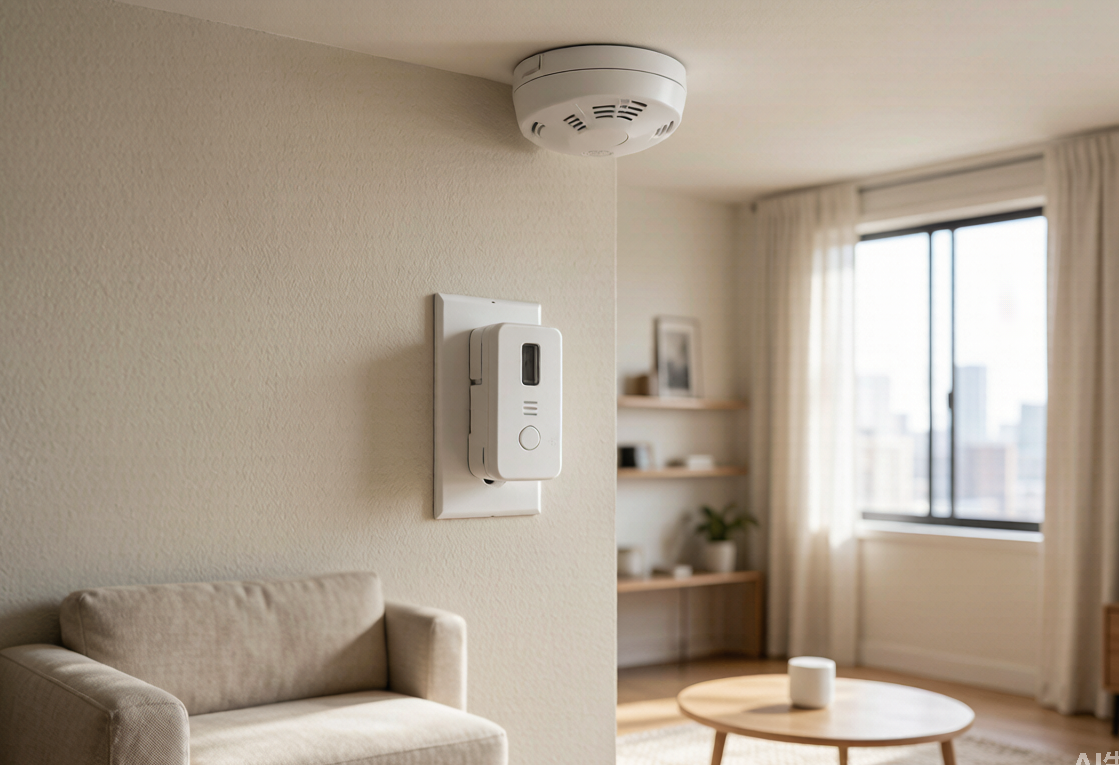
When you shop for a carbon monoxide detector, one choice drives everything else: how it gets power. Plug-in and battery models look similar on the shelf, but they behave very differently during the exact moment you need them — a power outage, a dead battery, or a slow CO leak while you sleep.
This guide compares plug-in and battery carbon monoxide detectors on power, maintenance, placement, and real-world failure modes, then explains why a plug-in unit with a built-in battery backup is the configuration most homes should aim for.
How a plug-in carbon monoxide detector works
A plug-in CO detector draws power from a wall outlet. Most models include a digital display, audible alarm, and sometimes a backup coin-cell or small rechargeable pack for short outages.
Where plug-in wins:
- No battery swapping for daily power. As long as the outlet has electricity, the unit runs indefinitely.
- Room for a digital readout. Wall power supports a bright PPM display, which helps you track trends rather than waiting for a threshold alarm.
- Easy to install. You plug it in near an outlet, usually 5 feet off the floor.
- Often cheaper up front. Plug-in units are widely available and competitively priced.
Where plug-in falls short:
- It dies when the power does. A storm, grid failure, or tripped breaker silences a pure plug-in detector. Carbon monoxide risk from generators, gas furnaces, and fireplaces is highest precisely during outages.
- Outlet placement limits you. You can only put it where an outlet exists, which may not be the ideal height or room.
- Backup cells are usually small. Many plug-in units only carry a short-lived coin cell, not a real backup for a multi-hour outage.
How a battery carbon monoxide detector works
A battery-operated CO detector runs entirely on batteries, with no wall connection. There are two main subtypes:
- Replaceable battery models use AA or 9V cells you change yourself, usually once a year.
- 10-year sealed battery models ship with a non-removable lithium cell rated for the device's full life, so you never buy batteries.
Where battery wins:
- Works during any power outage. No grid, no problem.
- Place it anywhere. Ceiling, wall, hallway, cabin, RV, garage — no outlet required.
- Sealed 10-year units remove maintenance. No annual battery shopping, and a built-in end-of-life signal tells you when to replace the whole device.
Where battery falls short:
- Battery life is a failure point. A dead or missing battery is the most common reason a CO alarm goes silent. Replaceable models depend on you remembering to swap cells.
- No easy digital display on many units. To save power, basic battery models skip the screen and only beep at threshold.
- Sealed units must be replaced whole. When the 10-year cell expires, you discard the device even if the sensor is fine.
Plug-in vs battery: head-to-head
| Factor | Plug-in | Battery (replaceable) | Battery (10-year sealed) |
|---|---|---|---|
| Power during outage | Fails unless it has a strong backup | Works | Works |
| Daily power source | Wall outlet | You supply batteries | Built-in, no swaps |
| Maintenance | Low (outlet-powered) | Annual battery change | None until end-of-life |
| Placement flexibility | Limited to outlets | Anywhere | Anywhere |
| Digital PPM display | Common | Rare (power-saving) | Rare |
| Common failure mode | Outage silence | Forgotten dead battery | Expired sealed cell |
No single column wins every row. The honest answer is that each type has a weakness that can leave you unprotected at the worst time.
The decision comes down to four questions
1. Does your CO risk rise during outages?
If you run a generator, use a fireplace, or rely on gas heat, outages are exactly when CO danger climbs. A unit that depends on wall power alone is a liability then. See our generator carbon monoxide safety guide for placement distances. Our dedicated guide on what happens to a CO detector during a power outage covers how long battery backup actually lasts.
2. Will you actually maintain it?
A battery model is only as good as its battery. If you tend to ignore chirps or forget annual swaps, a sealed 10-year unit removes that burden. A plug-in with a real backup removes it too.
3. Where does it need to go?
Battery detectors win for ceilings, garages, RVs, and cabins where no outlet exists. Plug-in units are fine for a living-room wall with a nearby outlet.
4. Do you want to see the trend, not just the alarm?
A digital PPM readout lets you catch a slow creep toward dangerous levels. Wall-powered units support this far more often than battery ones. Our safe CO PPM levels chart shows why the number matters.
Why plug-in with battery backup is the safest setup
The strongest configuration combines both power sources: a detector that plugs into the wall for everyday power and seamlessly switches to a built-in battery backup when the outlet loses power.
This design removes the two biggest failure modes at once:
- It does not go silent during an outage, because the battery takes over.
- It does not depend on you remembering to buy and swap cells, because the backup is built in and rechargeable.
- It can still carry a digital display, because wall power handles the screen during normal operation.
For most homes — especially those with gas appliances, attached garages, or generator use — plug-in plus built-in battery backup is the practical sweet spot. A pure plug-in unit risks silence during storms; a pure battery unit risks a forgotten dead cell. The hybrid avoids both. That is the design behind the HD16 plug-in monitor with battery backup.
Placement still matters more than the power source
Whatever you buy, placement determines whether it protects you:
- Install a detector within 10 feet of every sleeping area, because CO symptoms progress while you are unconscious.
- Mount it at breathing height on the wall (roughly 5 feet) or on the ceiling, away from direct drafts and steam.
- Put one on every level of the home, including the basement if you have fuel-burning equipment there. Read our basement CO alarm guide for specifics.
- Do not place it right next to a fuel-burning appliance or in dead-air corners.
A well-placed battery detector beats a poorly placed plug-in unit, and vice versa. Power source and placement are both non-negotiable.
Why a 6-in-1 detector fits this role
A home gas leak detector that also senses carbon monoxide, smoke, temperature, and humidity consolidates the devices you would otherwise mount separately. Carbon monoxide from exhaust or furnaces, combustible gas from a stove or propane line, and smoke from an overheating cord are all tracked by one unit.
The VASAIKO HD16 is tested to UL 2034, UL 1484, and UL 217 standards, CE & FCC certified, and RoHS compliant. It plugs into standard AC power (100–240V, global voltage) with a built-in battery backup, so it keeps monitoring through an outage instead of going dark. The digital display shows live PPM readings, which helps you tell the difference between a stressful day and an actual CO trend.
If you are choosing between plug-in and battery, the better question is often: *why not both?*
Common questions
Is a plug-in CO detector safe if the power goes out?
Only if it has a genuine battery backup. A pure plug-in unit with no backup goes silent the moment the outlet loses power — which is often when CO risk is highest.
Do 10-year sealed battery detectors need any maintenance?
No battery swaps. You only replace the whole unit at end-of-life, when its built-in signal tells you the cell has expired. Check it monthly with the test button like any alarm.
Why does my battery CO alarm keep chirping?
A single chirp every 30–60 seconds usually means a low or end-of-life battery. Four rapid beeps with a pause is the CO alarm pattern. Our CO detector beeping guide breaks down every pattern.
Can I use a plug-in detector in an RV or cabin?
Only where you have reliable AC power. For RVs, cabins, and garages without steady outlets, a battery or battery-backup unit is the right call.
Do I still need one if I have smoke alarms?
Yes. Smoke alarms detect fire particles, not carbon monoxide. The two threats are different, and a smoke vs CO detector comparison explains why you need both.
Final takeaway
Neither plug-in nor battery is universally better — each has a failure mode that can leave you unprotected. Plug-in units can go silent in an outage; battery units can die on a forgotten cell. The safest choice for most homes is a plug-in detector with a built-in battery backup, which keeps working through storms while sparing you battery maintenance. One unit built that way is the VASAIKO HD16.
Pick the power source that fits your home, then obsess over placement: within 10 feet of bedrooms, on every level, at breathing height. Power source and placement together are what actually keep a CO detector working when it matters.