
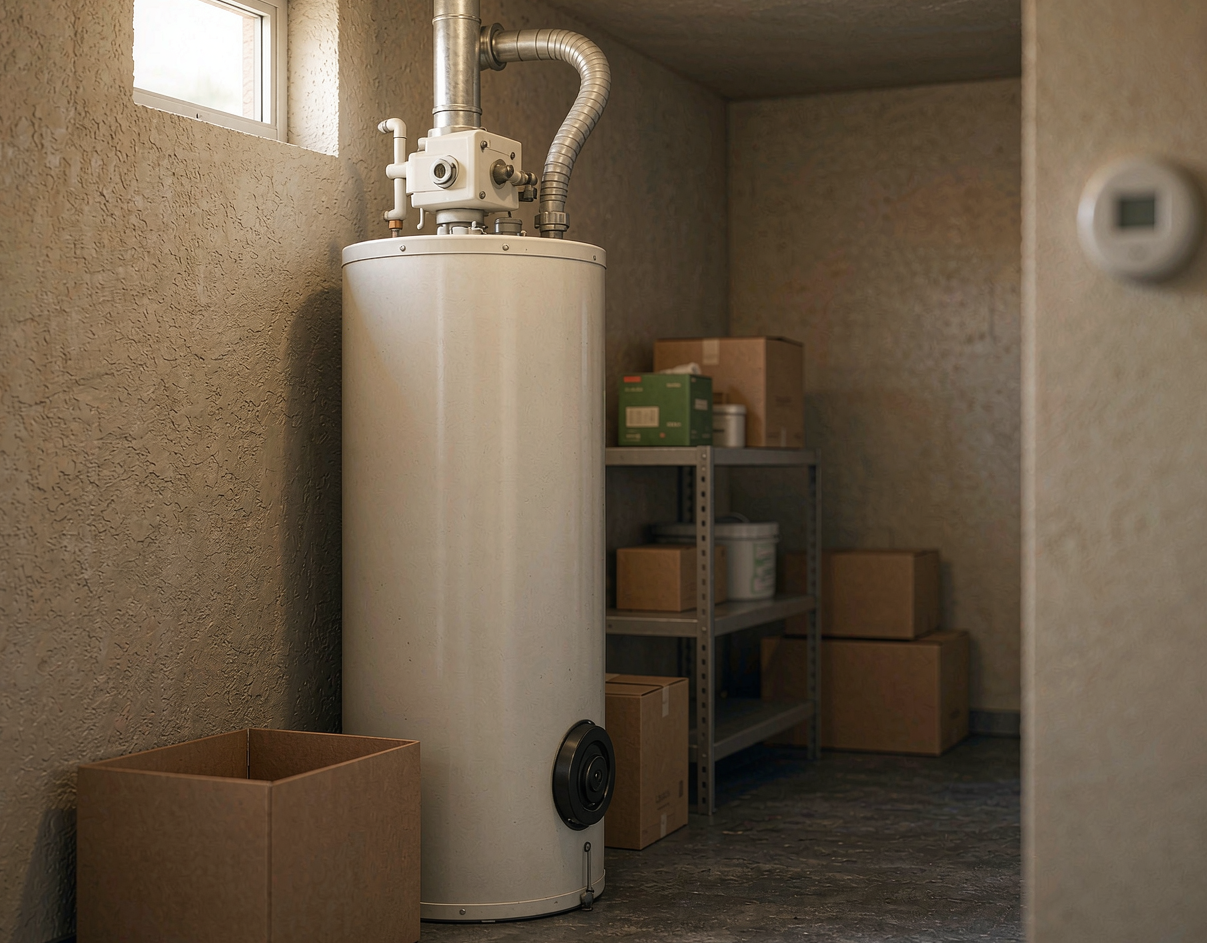
A gas water heater burns fuel dozens of times a day, usually in a basement, utility closet, or garage where nobody is watching. For the appliances that often share that same mechanical room — the furnace and the boiler — the placement rules are covered separately in our CO detector guide for furnace and boiler rooms. When combustion is healthy, that burner produces carbon dioxide and water vapor. When it is not, it produces carbon monoxide — and a failing water heater is one of the most frequently diagnosed sources of chronic low-level CO exposure in American homes.
What makes it dangerous is the pattern. A water heater does not usually fail catastrophically. It drifts: a partially blocked flue, a rusted draft hood, a house that has been air-sealed enough to go slightly negative in pressure. Each change nudges combustion a little further from complete, and the exhaust that used to go up the chimney starts spilling into the room instead.
This guide covers how gas water heaters generate CO, the specific visual and symptomatic warning signs of a unit that is slipping, why backdrafting is the mechanism behind most of it, and exactly where a CO alarm belongs relative to the appliance.
Why a gas water heater makes carbon monoxide
Carbon monoxide is the product of incomplete combustion — fuel that burned without enough oxygen, or burned at the wrong temperature, or had its flame cooled before combustion finished.
A properly tuned gas burner produces a crisp blue flame and converts essentially all of the fuel's carbon into CO₂. Three things push it off that path:
- Not enough combustion air. An atmospheric water heater pulls the air it burns from the room around it. Starve it of oxygen and the flame cannot complete combustion.
- A weak or reversed draft. Flue gases need to move up and out. If the chimney is cold, blocked, undersized, or the house is depressurized, exhaust backs up instead.
- A dirty or damaged burner. Dust, rust scale, spider webs in the burner tube, or a misaligned burner changes the air-fuel mix locally.
The result is CO at the appliance, and — critically — CO that does not leave the building.
Normal combustion and incomplete combustion look different. Here is the practical comparison:
| What you observe | Normal | Indicates a problem |
|---|---|---|
| Burner flame | Crisp blue with a stable cone | Mostly yellow, orange, or "lazy" and lifting |
| Flame tip | Small blue cone, may show slight yellow tipping on propane | Large, persistent yellow or orange flames throughout |
| Top of the unit | Clean, no deposits | Soot, black streaking, or scorching around the draft hood |
| Flue pipe | Intact, tight joints, no staining | Rust scale, white chalky deposits, water streaks, or loose sections |
| Draft hood area | Undamaged | Melted, warped, or deformed metal or plastic |
| Odor near the unit | None | Persistent "exhaust" or sharp smell during or after firing |
| Pilot | Stays lit | Repeatedly goes out |
A note on odor: carbon monoxide itself has no smell at all. The rotten-egg smell people associate with gas is mercaptan, an additive to the natural gas supply — it warns of a *gas* leak, not of CO. If you smell it, that is a separate emergency and our home gas leak detector placement guide covers the response.
Backdrafting: the mechanism behind most water heater CO events
Backdrafting is what happens when flue gas flows *backwards* — out of the draft hood and into the room instead of up the chimney.
A natural-draft water heater relies on buoyancy: hot exhaust rises, which pulls fresh combustion air in behind it. That only works if the house is at roughly neutral pressure and the chimney is warm enough to maintain draft. Break either condition and the flow reverses.
Common causes, in rough order of frequency:
- House depressurization. A clothes dryer, a powerful kitchen range hood, a bathroom exhaust fan, or a whole-house fan pulls air out of the building. If replacement air cannot get in fast enough, the house goes negative and the path of least resistance becomes *down the water heater flue*. This is the single most common cause, and it has gotten more common as homes have been air-sealed for energy efficiency.
- A blocked or damaged chimney. Bird nests, creosote, collapsed liners, rust scale, or debris at the terminal.
- A cold chimney. A tall exterior masonry chimney in winter can be colder than the flue gas, killing the draft until it warms up. This is why spillage often happens on the first morning firing.
- Oversized or undersized venting. Wrong diameter or too many elbows adds resistance the natural draft cannot overcome.
- A shared flue with a larger appliance. A furnace firing can overwhelm a shared chimney and push its own exhaust out through the water heater's draft hood.
The tell-tale sign of backdrafting is spillage that stops when a window is opened. If symptoms, soot, or alarm events in the utility area disappear when you crack a window, you are looking at a pressure problem, not a sensor problem.
Because spillage is intermittent, an alarm that only beeps and resets will not tell you much. A detector that logs or displays peak PPM gives you the evidence a technician needs — which is why the HD16 6-in-1 detector shows a live digital reading rather than a single threshold beep.
If you want to understand what the alarm is actually measuring during a spillage event, our safe CO PPM levels chart maps readings to time-to-alarm and symptom thresholds.
Warning signs in people, not just in the appliance
Many households notice the human symptoms before they notice anything wrong with the water heater. The pattern is distinctive:
- Headaches that are worse at home and better at work or after leaving the house
- Symptoms that cluster in the morning — the water heater fires hardest after overnight standby and morning showers
- Multiple people and pets affected at once
- Nausea, dizziness, or unusual fatigue that resolves within an hour or two of leaving
- Symptoms that appear or worsen when the dryer or range hood is running
That last one is the strongest clue, because it points at depressurization as the mechanism.
None of these are specific to CO — they overlap with flu, migraine, and simple exhaustion. The differentiator is the *pattern*: correlated with being in the house, correlated with appliance operation, and shared across occupants. If you want to see what a real event looks like numerically, the safe CO PPM chart breaks down concentration versus exposure time.
Water heater types and their CO risk profile
Not all gas water heaters carry the same risk. The venting design determines whether combustion air comes from inside the home and how strongly the flue is driven.
| Type | How it vents | Combustion air source | CO risk profile |
|---|---|---|---|
| Atmospheric (natural draft) | Buoyancy up a chimney or B-vent | Indoor room air | Highest. Spills easily if the house goes negative or the flue is compromised |
| Power vent | Fan-powered, horizontal through a side wall | Indoor room air | Moderate. Fan overcomes weak draft, but a failed fan or blocked terminal still spills |
| Direct vent (sealed combustion) | Sealed coaxial pipe through wall or roof | Outdoor air, sealed from the room | Lowest. Combustion is isolated from indoor air |
| Tankless (condensing, sealed) | Sealed PVC/polypropylene vent | Outdoor air | Lowest. Sealed combustion plus high-efficiency burners |
| Tankless (non-condensing) | Metal vent, higher flue temp | Varies by model | Low to moderate. Check whether the model is sealed-combustion or room-draft |
If you are replacing a water heater, sealed combustion (direct vent) removes most of the backdrafting risk by design, because there is no open draft hood communicating with the room.
Where to put a CO alarm near a water heater
This is where most people get it wrong in one of two opposite directions: either no alarm anywhere near the appliance, or an alarm mounted directly in the exhaust plume.
Both are mistakes. The correct answer is in the same space, but outside the immediate plume and at a distance the manufacturer approves.
The rules that actually matter
- Never mount directly above the water heater or inside the draft hood plume. Hot, dirty flue gas will trigger nuisance alarms and shorten sensor life.
- Respect the manufacturer's minimum separation. Most CO alarm manufacturers specify a minimum distance from fuel-burning appliances — commonly in the 5–15 ft range — precisely to avoid nuisance trips from trace CO during normal startup.
- Put it where people breathe. Carbon monoxide has nearly the same density as air and mixes thoroughly rather than pooling high or low. Wall mounting at roughly head height, or per the manufacturer's instruction, is correct. Our CO detector placement and height guide covers the full reasoning.
- Cover the sleeping level as well. A single alarm in the basement does not satisfy the safety objective. Alarms belong on every level and outside sleeping areas.
- One alarm is not a system. A water heater CO event is a whole-house event. Interconnected or multiple units mean the alarm is heard where people actually are.
Situation-specific placement
Water heater in an open basement. Mount on a wall in the same room, at least the manufacturer's minimum distance away, not directly above the unit, and not tucked behind the flue or in a dead-air corner. Basements deserve their own treatment — see our basement CO alarm guide.
Water heater in a louvered utility closet. Mount outside the closet on the adjacent wall. Inside the closet you get heat, direct plume exposure, and an alarm nobody hears.
Water heater in the garage. Follow the alarm manufacturer's guidance for garage installation, and remember that vehicles are an additional CO source. Our garage carbon monoxide detector guide covers the specifics, including elevation.
Water heater in a hallway or bathroom-adjacent space. Steam and cleaning-product vapor cause nuisance alarms. Keep separation from showers and humid rooms — the same triggers listed in our false alarm causes guide.
A combination unit that monitors CO, combustible gas, temperature and humidity gives you more than a binary alarm: a digital PPM readout lets you see a low-level chronic problem that never reaches the alarm threshold but still matters. That distinction is exactly what separates a nuisance event from a genuine appliance failure. If you want to see the HD16 6-in-1 detector we build for this, it is here.
If the alarm goes off: the eight-step response
- Get everyone out, including pets. Open doors on the way out if it costs no time.
- Do a head count outside.
- Call 911 or your fire department. Most departments will meter the house at no charge and can identify the source.
- Note the reading if your unit has a display, and note the time.
- Do not re-enter until the space is ventilated and cleared.
- Do not relight the water heater pilot yourself after a confirmed CO event.
- Have the appliance and venting inspected by a licensed technician before it fires again.
- Seek medical attention if anyone has headache, dizziness, nausea, or confusion — and say plainly that CO exposure is possible.
If the alarm reset to zero within a minute or two of fresh air, that is evidence pointing at a nuisance trigger rather than a sustained leak — but it is not proof, and it does not remove the need to find out why it fired.
Prevention: the annual checklist
Most water heater CO problems are visible long before they become emergencies.
- Annual professional inspection of the burner, draft hood, and venting. Ask specifically for a spillage and depressurization test — not just a visual look.
- Keep combustion air openings clear. Do not block louvers, grilles, or the gap under a utility room door.
- Keep clearance around the unit. Storage pressed against a water heater restricts airflow and creates a fire hazard.
- Never cap, block, or modify the draft hood. It is a safety device.
- Watch the flame. Look at it once or twice a year through the sight glass. Blue with small yellow tips is normal; a broadly yellow, lazy flame is not.
- Check the flue for rust, scale, separation, and water streaks.
- Run bath and kitchen exhaust fans in moderation, and be aware of the combined effect when the dryer and range hood run at the same time as the water heater.
- Know the appliance age. Tank water heaters typically last 8–12 years. A unit at the end of its life is a candidate for replacement, not repair.
Detection is the layer that covers everything else. A CO alarm with a built-in battery backup keeps protecting you during the power outages that also tend to coincide with heating-season CO incidents, and a unit with a digital display turns an ambiguous beep into a number you can act on. The HD16 is a 6-in-1 detector covering carbon monoxide, combustible gas, smoke, temperature and humidity — details here.
FAQ
Can a gas water heater produce carbon monoxide if the flame looks blue?
Yes. Flame color tells you about combustion at the burner, not about whether the exhaust is leaving the building. A blue flame with a blocked flue or a depressurized house still spills CO into the room.
Should the CO alarm be right next to the water heater?
No. Mount it in the same space but at the separation distance the manufacturer specifies, away from the direct flue plume. Too close means nuisance alarms; too far means diluted readings and late warning.
Why does it only happen in the morning?
The first firing after overnight standby often starts with a cold chimney and a house that is slightly negative in pressure. Once the chimney warms and daily activity changes the pressure balance, the spillage stops.
Does an electric water heater produce CO?
No. Electric resistance elements produce no combustion and no CO. If you have an electric water heater and a CO alarm is sounding, the source is elsewhere.
Will opening a window fix backdrafting?
It usually stops the immediate spillage, which is a useful diagnostic — but it is a test result, not a fix. The underlying cause (blocked flue, undersized combustion air, excessive exhaust fan capacity) still needs correcting.
How often do CO alarms near water heaters false-alarm?
Startup puffing and small amounts of CO during normal firing can trip an alarm mounted too close. Correct siting distance resolves most of it. If alarms persist at a proper distance, treat it as a real finding and have the appliance tested — the false alarm guide walks through the remaining causes.
Does a CO alarm also detect a gas leak?
Not usually. CO alarms sense carbon monoxide; combustible gas detection is a separate sensor. A combination unit covers both — our combination CO and gas detector buying guide explains what to look for, and our kitchen gas leak alarm guide covers the gas side specifically.
How long will the alarm itself keep working?
CO sensors have a finite life, typically 5–10 years depending on the model, and units announce end-of-life rather than failing silently. Replacement intervals are covered in our guide on how long CO detectors last.
The bottom line
A gas water heater is the appliance most likely to be quietly producing carbon monoxide in a space nobody occupies. The failure mode is slow, the early signs are physical — soot, rust on the flue, a yellow flame — and the underlying mechanism is usually depressurization rather than a broken part.
Two actions cover nearly all of the risk: put a CO alarm in the same space as the appliance at a manufacturer-approved distance, and have the venting and combustion air tested annually. A unit with a digital PPM display makes the difference between guessing and knowing, because it shows the low-level chronic exposure that never reaches the alarm threshold but still affects the people living there.
The VASAIKO HD16 monitors carbon monoxide, combustible gas, smoke, temperature and humidity in one unit, with a digital display and built-in battery backup so it keeps working through a power outage. It is tested to UL 2034, UL 1484 and UL 217 standards, CE & FCC Certified, and RoHS Compliant. See the full specification.