
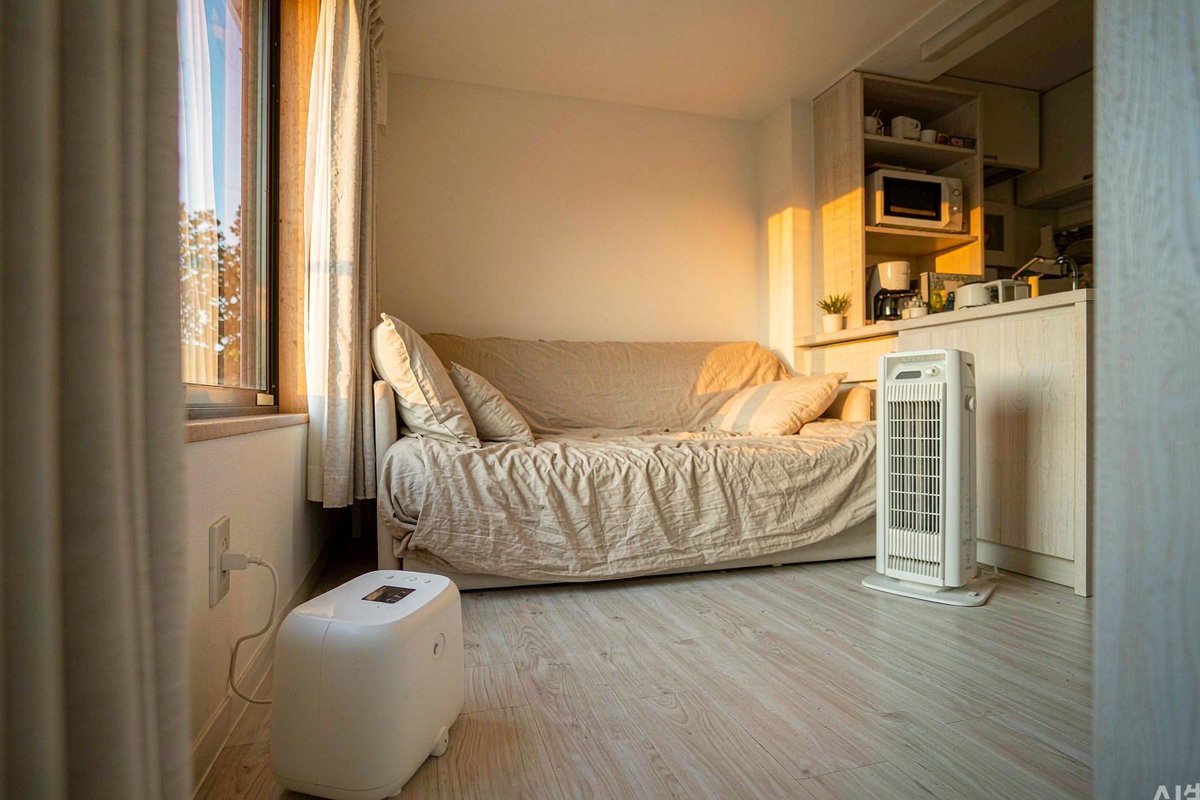
The main house has three carbon monoxide detectors. You tested them last spring, you know where they are, and you know what the chirp means. Then someone asks whether the guest house behind the garage is covered, and the honest answer turns out to be complicated.
A secondary dwelling is not just another room that happens to have a door. It has its own roof, its own air, frequently its own water heater or cooktop, and sometimes its own reasons to be closed up for weeks at a time. It is also the part of a property most likely to be finished after the main house was already signed off, which is exactly how a sleeping space ends up with no carbon monoxide alarm at all.
This guide is about that gap: where CO comes from in a guest house or accessory dwelling unit, how many detectors the space actually needs, and the specific things to check before a parent, a grown kid, or a long-term renter sleeps there.
Why a Guest House Has Its Own Carbon Monoxide Profile
Carbon monoxide behaves differently in a small detached unit than it does in a family home, and the difference comes down to three things: volume, occupancy pattern, and appliance count.
Volume works against you. A studio ADU of 400 square feet has a fraction of the air volume of a 2,000 square foot house. The same amount of CO from a misbehaving appliance produces a far higher concentration in a smaller space, and it reaches a level you would notice much sooner. Small spaces do not dilute, they concentrate.
Occupancy is intermittent. A guest house may sit empty for three weeks, then house someone every night for a month. Appliances that have not run in a while get fired up the same day the occupant arrives. A water heater that has been idle, a cooktop used hard after months of disuse, a space heater pulled out of a closet for the first night of a cold snap: all of these are the moments when combustion is least settled.
The occupant does not know the building. Someone staying in your main house knows which burner runs orange, which door sticks, and that the water heater makes a noise. A guest does not. Neither does an elderly parent moving into an in-law suite, or a tenant signing a year-long lease. They have no baseline for what normal looks like in that space, which means they also have no way to notice that something has changed.
That combination is why a guest house deserves its own detector plan rather than inheriting whatever was left over from the main house.
Start With One Question: Does the Space Burn Anything?
Everything else follows from this. Walk into the unit and list every device that makes flame or heat from combustion:
- Gas or propane cooktop, oven, or range
- Tank or tankless gas water heater (check a utility closet, a garage corner, or an exterior cabinet)
- Gas furnace, wall heater, or gas fireplace
- Propane space heater or portable heater
- A generator, even one stored nearby rather than installed
- Gas dryer
If the answer is none of the above and the unit is entirely electric, the CO risk from the unit's own appliances is low. That does not end the assessment, because CO also arrives from somewhere else. Check these three paths:
- Is there an attached garage, or is the unit under or beside one? A car left running, a lawn mower warmed up inside, or a generator on the far side of that shared wall all push CO into the dwelling. Our guide to CO alarms for an attached garage covers the pressure and doorway mechanics in detail.
- Does the unit share a wall, floor, or ceiling with the main house? Shared assemblies are shared air paths. Recessed lights, plumbing chases, and unsealed penetrations move gas between spaces that look completely separate from the outside.
- Is anything combustion-powered parked within about 20 feet? Generators, pressure washer engines, and idling vehicles outside an open window are a documented route into a small space. If a generator is part of the property plan, read generator carbon monoxide safety before you position it.
If the unit has its own fuel-burning appliance, or any of the three paths above is true, it needs at least one carbon monoxide alarm of its own.
Detached, Attached, or Converted: Three Different Plans
The physical relationship between the secondary unit and the main structure changes how you cover it.
| Unit type | Typical CO sources | Detector plan | Common miss |
|---|---|---|---|
| Detached guest house / casita | Own water heater, cooktop, or space heater; propane tank | One alarm in the unit, outside the sleeping area; a second on any upper sleeping level | Assuming the main house alarm covers it |
| Attached ADU (shared wall) | Own appliances plus migration from the main house garage | One in the unit, one in the main house near the shared wall | Treating the shared wall as a seal |
| Garage conversion | Under-insulated envelope, old garage door gaps, vehicle history | One in the unit, plus one in the remaining garage if any | Forgetting that the building used to hold running cars |
| Above-garage unit | Vehicle exhaust below, shared floor assembly | One in the unit near the stair, one in the garage | Placing only in the garage, not the living space |
| Basement or lower-level suite | Shared furnace and water heater room | One in the suite, one in the mechanical room | Basement CO alarm placement errors |
Conversions deserve extra scrutiny. A garage that became a studio usually still has the original door frame, the original slab-to-wall junction, and the original ventilation assumptions, none of which were designed for someone sleeping there.
Where the Risk Actually Sits in an ADU
Once you know something burns, the next question is where. In a small unit, the appliance is rarely in a separate mechanical room. It is in the kitchen, in a closet, or in a corner of the main room.
Kitchenettes are the usual suspect. A gas cooktop in a studio is often closer to the bed than any cooktop in a main house would be to a bedroom. Extended simmering, a burner that lights late, or an oven used as a room heater on a cold morning all put combustion products directly into breathing air. Our kitchen gas leak alarm guide covers what a kitchen installation needs beyond CO alone.
Tankless water heaters in closets. Popular in ADUs because they are compact, and often mounted in a hallway closet or exterior cabinet with a louvered door. If that louver opens into the unit's air, a flue problem vents into the living space rather than outside.
Space heaters are seasonal and unmonitored. A propane or kerosene heater in a guest house is the single most common way CO enters a secondary unit, because it is brought out precisely when the space is cold and closed up. Space heater carbon monoxide risk walks through the use patterns that cause trouble.
Fireplaces in converted or rustic units. A wood or gas stove in a small volume is a draft problem waiting for the wrong weather. If the unit has one, fireplace carbon monoxide detectors covers the backdraft and pressure cases.
How Many Detectors a Guest House Needs
The rule that keeps showing up in residential guidance is straightforward: one alarm outside each separate sleeping area, and one on each level including the basement. In a secondary unit, that translates to:
- Studio layout, single level: one alarm in the main space, positioned so it is audible from the bed but not so close to the kitchenette that cooking sets it off.
- One-bedroom ADU: one in the hallway or just outside the bedroom door, one in the main living level.
- Two-level unit or loft sleeping: one on the lower level, one on the upper sleeping level near the stair head.
- Unit with an attached garage: one in the living space, and do not rely on a garage-mounted unit alone.
If you want the full reasoning including edge cases like open-plan sleeping lofts, how many CO detectors you need lays out the counting method.
For a small property, the practical answer is usually two units for the guest house and the existing coverage in the main house. It is worth checking what the main house has while you are at it, because the same inspection trip answers both.
> A note on multi-packs: covering a main house and a guest house usually means three or four alarm locations at once. If you are equipping both buildings in one go, a multi-unit pack avoids the situation where the guest house gets the leftover unit from a shelf. See the VASAIKO HD16 detector for the plug-in display monitor we build for this kind of multi-space coverage.
Placement Height and Distance in a Studio Layout
Carbon monoxide mixes with room air rather than pooling at the ceiling or the floor, which is why CO alarms are not mounted like smoke alarms. The practical guidance most manufacturers give is eye level or a few inches below the ceiling, and away from the immediate appliance zone.
In a small unit, three mistakes are common:
Too close to the cooktop. Under about 10 to 15 feet from a gas range, an alarm can see short-lived trace amounts from normal ignition and lighting. That produces nuisance alarms, and nuisance alarms produce removed batteries. Put it outside the immediate cooking zone but still in the same air volume.
Behind a door or inside a closet. A studio often has limited wall space, so the alarm ends up in a wardrobe or behind the bathroom door. Sound does not carry well through a closed door, and an alarm you cannot hear at 3 a.m. in a different room than the occupant is not doing its job.
Directly in the path of a vent or fan. Supply registers, bath fans, and range hoods change local air movement enough to matter in a small volume. Avoid mounting within a few feet of a strong supply vent.
The full reasoning behind height, including why knee-level and ceiling-level both have arguments, is in CO detector placement height.
The Occupant Does Not Know the House
This is the part that separates a guest house from every other scenario on this site.
In your own home, you notice changes. A burner that lights with a small pop, a water heater that runs longer than it used to, a faint smell in the utility closet on a cold morning. You may not act on them, but you register them.
A guest, a new tenant, or a relative settling into an in-law suite has no baseline. They do not know that the pilot light used to be blue, that the heater used to click twice, or that the kitchen window is the one that should be cracked when the oven runs for an hour. Small behavioral cues that protect an experienced occupant simply do not exist for them.
Two things help. First, a written page in the unit: where the detector is, what the alarm sounds like, what to do, what not to run, and who to call. Second, a detector that shows a number rather than only sounding an alarm. An occupant with no experience of the building can look at a display and answer the question "is this normal right now" without any prior knowledge of the space. That is the argument for a CO detector with a digital display in a secondary unit specifically.
Closed Up Between Stays: The Reading You Never See
A guest house spends a lot of time sealed. Windows latched, door locked, no air exchange worth the name. Then someone arrives, opens the door, runs the shower, and starts dinner.
That transition is when two things happen at once: combustion appliances fire up after an idle period, and the building goes from static to active. If something is off, the first hours of occupancy are when it shows.
A detector with a visible readout turns that into something you can check. Before handing over keys, plug in, wait through the warm-up period, and look at the number with nothing running. Then run the shower and the cooktop and look again. You are not looking for a specific value so much as a change: a reading that climbs when an appliance runs and does not return is worth a service call before anyone sleeps there.
For reference on what different ranges mean, see the safe CO ppm levels chart.
Power, Subpanels, and the Battery Backup Question
Guest houses and garage conversions are often fed from a subpanel, and the outlet layout inside them is usually sparse. This matters because a plug-in detector needs an outlet, and a hardwired one needs a circuit.
Three things to verify:
There is an outlet where the detector should go. Not just somewhere in the room. If the only free outlet is behind the sofa or inside the kitchenette, you need either an extension of the circuit or a battery-powered unit for that location.
The outlet is not switched. Conversions frequently have switched outlets where a lamp used to be. A detector on a switched outlet goes dark the moment someone flips the wrong switch.
Backup power is real, not nominal. If the area loses power in winter storms, a plug-in unit with an internal battery keeps reading through the outage. A unit with no backup goes dark exactly when a space heater or generator is most likely to be in use. Our CO detector power outage guide covers what to look for, and plug-in vs battery detectors compares the two approaches honestly.
Why Interconnect Usually Stops at the Property Line
In a main house, interconnected alarms are a clear win: one senses, all sound. Across a property line, that logic mostly breaks.
Wireless range. A detached guest house 60 feet away, through two exterior walls and possibly a garage, is outside the reliable range of most consumer wireless interconnects. Manufacturers publish range figures measured in open air, not through a wall assembly with foil-faced insulation.
Hardwiring across structures. Running interconnect wiring between buildings means conduit, burial depth, and often a permit. It is rarely worth it for a CO alarm.
The occupant may be different. If the guest house has a long-term tenant, they are not going to respond correctly to an alarm sounding in a building they cannot enter. A local alarm in their own space is more useful than a remote one in yours.
The practical conclusion: give the secondary unit its own alarm that sounds where the occupant is. Do not rely on hearing it from the main house, and do not rely on the occupant hearing yours. That means a self-contained unit per building, ideally one that keeps reading rather than going dark if power drops at the property. The VASAIKO HD16 page shows the plug-in monitor design we use for that case.
A Weekend Checkout Sequence Before Someone Sleeps There
If the unit has no detector today, this is the order we would do it in. It takes one afternoon and no tools beyond a screwdriver and a phone camera.
| Step | Action | What you are looking for |
|---|---|---|
| 1 | Inventory combustion appliances in and near the unit | Anything with a flame, plus any attached garage |
| 2 | Confirm the unit's layout type | Studio, one-bedroom, or loft determines count |
| 3 | Choose locations | Outside sleeping area, away from cooktop, off switched outlets |
| 4 | Install and power up | Allow the full warm-up period before trusting a reading |
| 5 | Take a baseline reading with nothing running | A stable low reading with no appliances in use |
| 6 | Run the water heater and cooktop, re-read | A value that returns to baseline after appliances stop |
| 7 | Test the alarm button | Occupant should hear it from the bed |
| 8 | Write the one-page note | Where it is, what it sounds like, what to do, who to call |
| 9 | Set a replacement reminder | Detectors age even when the unit sits empty |
| 10 | Re-check at each change of occupant | Repeat steps 5 and 6 before a new person moves in |
Step 6 is the one people skip, and it is the one that actually finds problems. A detector that has never been compared against a running appliance has only told you that the room is fine when nothing is on.
Long-Term Renters, Family, and the Same Physics
It is worth saying plainly that the occupancy arrangement does not change the gas.
A mother-in-law suite occupied by family, a casita on a long-term lease, and a unit used occasionally by visiting friends all have the same combustion sources and the same air volume. What changes is documentation and responsibility, not physics.
If you rent the unit, the usual practice is that the landlord installs and maintains detectors and the tenant reports problems. Either way, install them before occupancy rather than after a request. If the unit is ever going to be listed for sale, note that selling a house with CO detectors comes up at inspection, and an uninspected secondary unit is a common finding. If you are unsure whether your lease or local rule treats the unit as a separate dwelling, apartment CO detector law explains how the distinction is usually drawn.
What the Reading Is Actually Telling You
A displayed number is only useful if you know how it behaves. Three patterns matter more than any single value:
A reading that rises while an appliance runs and returns afterward. Usually normal operation with poor local ventilation. Improve ventilation and re-check.
A reading that rises and does not return. This is the one that deserves a service call. Something is producing CO and the space is not clearing it.
A reading that appears only under certain weather or wind conditions. Draft-related, and often specific to a flue or vent termination. Note the conditions and pass them to the technician.
If you want to understand why readings move the way they do, CO detector false alarm causes covers the benign sources, and what a CO alarm beeping means separates alarm patterns from end-of-life chirps. For the symptom side, see carbon monoxide poisoning symptoms.
Where a Plug-In Display Monitor Fits
A guest house is a good case for a plug-in unit with a visible readout, for reasons specific to this scenario:
- The occupant is inexperienced with the building and benefits from a number, not just a sound
- The unit sits closed up, so a pre-arrival check is worth being able to do in one glance
- Occupancy is intermittent, so the reading at handover matters more than in a continuously occupied home
- There is usually at least one free outlet near floor level, which is also a sensible mounting height
The VASAIKO HD16 is a plug-in monitor built for exactly this: it shows the live CO reading on screen, runs on household power with an internal battery so it keeps reading through an outage, and refreshes the displayed value every couple of seconds. It is designed as a second layer alongside your existing alarm, not a replacement for one. You can see the full specification on the VASAIKO HD16 safety detector page.
If you are weighing standards and what certification language actually means, UL 2034 explained is the clearest starting point, and how long CO detectors last explains why a unit that sat unused in a guest house still needs replacing on schedule.
FAQ
Do I need a CO detector in a detached guest house?
If the unit has any fuel-burning appliance, an attached garage, or a shared assembly with a space that does, yes. A detached structure does not inherit the main house alarm's coverage, because CO does not travel across open air in any useful way and the sound will not reach anyone inside.
Does an all-electric ADU need one?
If it is truly all-electric with no attached garage and no shared wall with a combustion space, the risk from the unit itself is low. Many owners still install one, because garages, generators, and future appliance changes are common on the same property.
How many detectors for a studio guest house?
One in the main space at minimum, positioned outside the immediate cooking zone and audible from the bed. Add a second if there is a sleeping loft or an attached garage.
Can I use one of those combination smoke and CO units?
You can, provided it is installed where CO detection makes sense rather than where smoke detection does. Those two locations are not always the same. See smoke detector vs carbon monoxide detector for where they diverge, and combination CO and gas detector buying guide if the unit also has a gas range.
Where exactly should it go in a 400 square foot unit?
Roughly eye level, on a wall that is not directly above the cooktop, not behind a door, and not within a few feet of a supply vent. In a space that small, the constraint is usually finding a wall that is far enough from cooking and still audible from the bed.
Will the main house alarms interconnect to the guest house?
Usually not reliably. Distance, exterior walls, and insulation all reduce wireless range well below the figures on the box. Treat the secondary unit as needing its own audible alarm.
What about a converted garage with the old door still in place?
Treat it as higher risk rather than lower. The original envelope was not built for occupancy, and vehicle exhaust history is a real factor. Install in the living space, not only in the remaining garage area.
The unit is empty most of the year. Does the detector still age?
Yes. Sensor life runs from manufacture, not from installation. A monitor in a rarely used guest house reaches its replacement date on the same schedule as one in daily use. See how long CO detectors last.
Should I put one in the guest house bathroom or kitchen?
No. Steam, cooking aerosols, and cleaning products are hard on sensors and produce false alarms. Put it in the living or sleeping volume instead.
How do I test that it works before someone arrives?
Press and hold the test button to confirm the alarm sounds, and confirm the occupant can hear it from the bed. Then take a reading with nothing running and a second reading after the water heater and cooktop have run. For the full method, see how to test a carbon monoxide detector.
My guest house has a tankless water heater in a closet. Is that a problem?
It is the configuration most worth checking with an actual reading. A louvered closet door means any flue issue vents into the unit's air rather than outside. Run the hot water for several minutes and watch whether the reading moves.
Is a display worth it versus a basic alarm?
In a secondary unit specifically, usually yes. The person in the space has no baseline for what normal looks like, and a number answers that question without any prior experience of the building.
The Short Version
A guest house is a separate dwelling with separate air, its own appliances, and occupants who have no idea what normal looks like there. Give it its own detector, place it where a small space actually allows, check it against running appliances rather than assuming silence means safety, and re-check it every time the occupant changes.
If you are equipping a main house and a secondary unit at the same time, the VASAIKO HD16 is built for multi-space coverage: a live reading on screen, household power with battery backup, and a refresh rate fast enough to watch a value move while an appliance runs.