
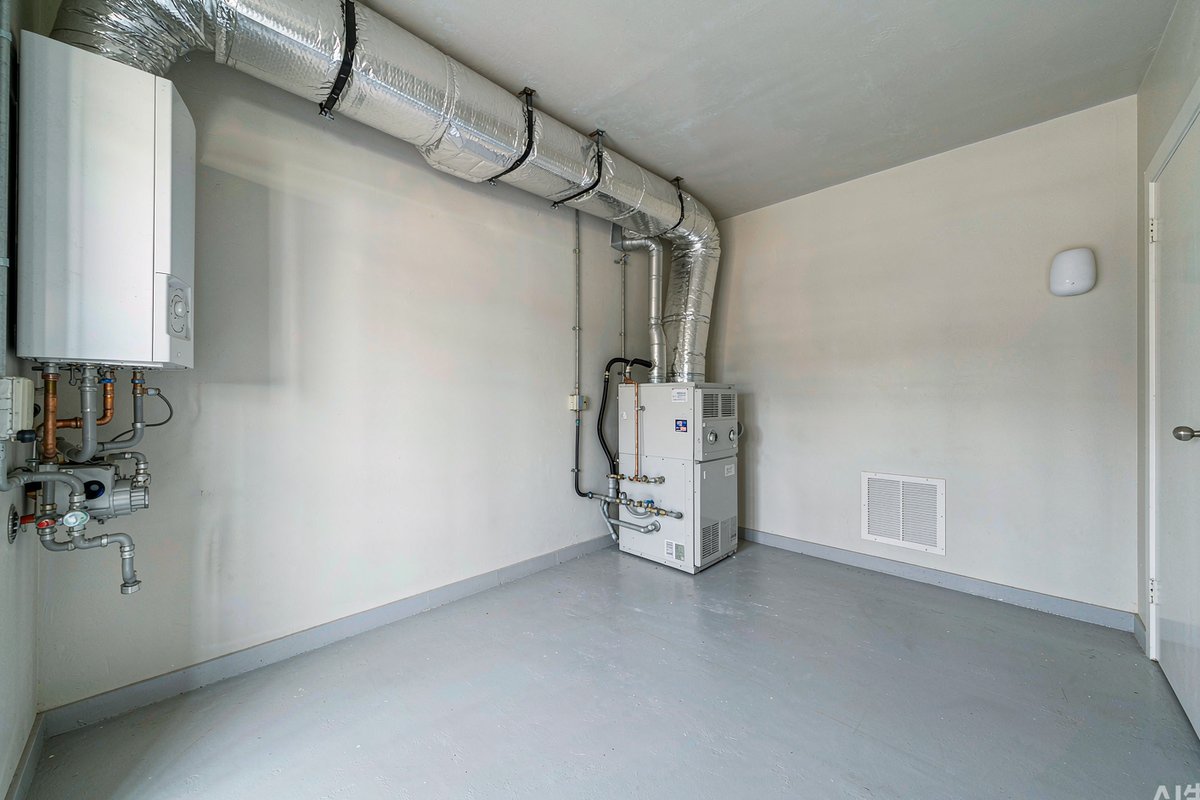
Your furnace is the single largest fuel-burning appliance in most American homes. It runs for hours at a time, it is usually tucked into a basement, closet, or utility room that nobody visits, and when it is working correctly it vents every byproduct of combustion outside where you never think about it again.
That last part is the whole story. A furnace is designed so that carbon monoxide leaves the building through a flue. When something interrupts that path — a cracked heat exchanger, a blocked vent, a house that pulls harder on the flue than the flue can push back — the same gas that was supposed to go outdoors ends up in your supply ducts, and your supply ducts end in every room of the house.
This guide covers how a furnace or boiler actually produces CO, the three mechanical failures that account for most of it, why boiler rooms behave differently from furnace closets, where a detector belongs in a mechanical room, and the specific spots in that room that will give you false readings.
Why the mechanical room is a different problem from the kitchen
Most CO guidance treats the house as a set of rooms with a stove in one of them. A mechanical room breaks that model in three ways.
It contains a continuous, high-output burner. A gas range gets used for twenty minutes at a time. A furnace in January may fire for several hours a day, every day, for weeks. Cumulative runtime is what turns a marginal combustion problem into a sustained one.
It is usually unoccupied and closed. A closed utility room door means no one is there to notice the smell of combustion byproducts, the soot streaking above the burner door, or the pilot flame that has gone lazy and orange. By the time the symptom reaches a living space, it has already traveled.
It is directly connected to the air you breathe. Supply plenum leaks, return-air gaps, and the combustion air openings that code requires in small mechanical closets all connect that room to the rest of the house. A CO problem in a utility room is rarely contained there. If your mechanical room is in the basement, the same structural factors covered in our guide to basement CO alarms apply on top of everything here.
How a furnace makes carbon monoxide
Complete combustion of natural gas or propane produces carbon dioxide and water vapor. Carbon monoxide appears when combustion is incomplete — when there is not enough oxygen, when the flame is cooled before it finishes reacting, when the fuel and air mixture is wrong, or when the flame is impinging on a cold metal surface.
Three mechanical conditions account for the large majority of furnace-related CO incidents.
1. A cracked heat exchanger
The heat exchanger is the metal assembly separating the combustion gases from the air that blows through your home. Combustion happens on the inside; household air passes over the outside. They are never supposed to mix.
Metal expands and contracts every time the furnace cycles. Over years, that fatigue can open a crack. When it does, combustion gases — including CO — enter the supply air stream and get distributed through the house at whatever the blower is pushing, which can be 800 to 1,200 cubic feet per minute.
Cracked heat exchangers are difficult for a homeowner to see. The visible signs are indirect: a flame that flickers or lifts when the blower starts, rust streaks inside the cabinet, excessive condensation on the inside of the flue pipe, or a furnace that short-cycles. An annual combustion test by a licensed HVAC technician is the actual detection method.
2. Blocked or disconnected venting
The flue has one job: carry combustion products out. Birds' nests, ice, snow at the termination, a disconnected joint, a sagging section of single-wall pipe, or a deteriorated masonry liner can all restrict or reverse it.
When the path out is restricted, pressure backs up into the combustion chamber. This is the failure mode that produces strong, immediate symptoms — because the blockage does not leak a little, it leaks everything.
3. Negative pressure and backdrafting
A house is a pressure vessel with a lot of holes. When something exhausts more air than the house can replace, indoor pressure drops below outdoor pressure, and the house pulls replacement air in through whatever opening is available — including the furnace flue, which then runs backwards.
Common depressurization sources: a powerful kitchen range hood, a clothes dryer, bathroom exhaust fans running together, a leaky return duct in a crawlspace, or a tight new window package installed on an older home that was originally built leaky enough to feed combustion air on its own.
This mechanism is worth understanding because it is seasonal and intermittent. A furnace can pass inspection in October and backdraft in January, when the house is closed up and the dryer and bath fans are running more often. Our article on common CO detector false alarm causes covers a related phenomenon — short-lived readings that appear and then vanish.
What makes boiler rooms different
A hydronic boiler heats water instead of air, which changes the failure map in useful ways.
No ductwork. A boiler sends hot water to radiators, baseboard convectors, or radiant floor loops. There is no supply plenum to carry combustion gas into every bedroom. This is a real structural advantage — a boiler CO problem tends to stay closer to its source than a furnace problem does.
Higher burner input in a smaller room. Boilers are frequently installed in tight closets or small basement rooms with louvered doors for combustion air. Less volume means a given leak produces a higher concentration faster.
Older cast-iron units with atmospheric burners. Many boilers in the Northeast and Midwest are decades old, atmospheric (not sealed-combustion), and vent into masonry chimneys that may no longer have an intact liner. An unlined or deteriorating chimney is a well-documented path for spillage back into the room.
The pump, not the burner, is what you hear. Owners often attribute every boiler sound to the circulator pump. Combustion-related changes — a yellow tipping flame, a rumbling ignition, soot at the burner door — are the signals that matter and are easy to miss.
Where the CO actually goes
Placement decisions make more sense once you understand transport.
| Path | Mechanism | Where it shows up first |
|---|---|---|
| Supply plenum leak | CO enters the pressurized air stream | Every supply register simultaneously |
| Return-air gap | Room air is pulled into the return | Near the return grille, then the furnace |
| Open combustion-air louver | Diffusion and convection through the opening | Hallway or room sharing the wall |
| Chimney spillage | Flue gas rolls out of the draft hood | Ceiling of the mechanical room, then upward |
| Backdrafting | Reversed flue flow during depressurization | Mechanical room, then the floor above |
The first row is the one worth internalizing. A cracked heat exchanger does not produce a local problem that gradually spreads. It puts CO into the airstream, which means the concentration in a second-floor bedroom can rise at roughly the same time as the concentration in the basement.
Where to put a detector in a mechanical room
The general placement rules are covered in detail in our placement height guide, but mechanical rooms have their own version of the answer.
Do not mount it directly at the flue or draft hood. The mouth of the draft hood is where a small, normal amount of spillage occurs during startup on many atmospheric units. A detector placed there will read transient values constantly and teach you to ignore it.
Do not put it in the dead-air corner behind the unit. Air does not circulate well behind a furnace or boiler, and a detector there responds slowly to a real event.
Do put it at breathing height in the room, on the wall that contains the door. CO mixes with air rather than pooling high or low, so a wall mount at roughly five feet works. Placing it on the wall with the door means it samples air that is actively leaving the room — which is the air that reaches the rest of the house.
Do consider a second unit in the living space. A mechanical-room detector tells you about the source. A detector in the hallway or bedroom tells you about exposure. They answer different questions, and in a house with forced air, the second one is the one that reflects what people are breathing.
Avoid the range of direct blower discharge and the direct path of a combustion-air louver if there is an alternative — both create fast, short spikes unrelated to a real leak.
| Location in a mechanical room | Recommendation | Reason |
|---|---|---|
| At the draft hood / flue mouth | Avoid | Normal startup spillage causes constant nuisance readings |
| Directly above the burner | Avoid | Heat, and it is inside the appliance's own air envelope |
| Behind the unit, corner | Avoid | Stagnant air, slow response |
| Wall with the door, ~5 ft up | Good | Samples air that is leaving the room |
| 10–20 ft from the unit, in the room | Good | Representative without being in the appliance's microclimate |
| Hallway outside the room | Good, as a second unit | Reflects what actually reaches living space |
Two units is the realistic answer for most mechanical rooms, and it is worth planning the pair rather than buying one and hoping. The VASAIKO HD16 product page shows the multi-pack configurations, which is usually the more sensible route than two separate single purchases.
Reading the number instead of waiting for the alarm
This is the practical argument for a detector that displays a live value.
Certified CO alarms are built around time-weighted thresholds: they are deliberately slower at low concentrations and faster at high ones, because that response curve reduces nuisance alarms. That is the right engineering choice for an alarm. It also means an alarm tells you nothing until the situation is already significant.
A display gives you the intermediate information. If you see a reading of 20–30 ppm while the furnace is running and it returns to zero when the furnace cycles off, that is a specific, actionable signal — it points at combustion, during operation, at a known piece of equipment. That is the moment to call an HVAC technician, and it is far earlier than an alarm would have fired.
The full reference for interpreting what you see is in our safe CO ppm levels chart. The response standards that certified alarms are tested against are explained in UL 2034, plain and simple.
If you are choosing a device for this, a unit that shows CO alongside combustible gas, temperature, and humidity gives you more diagnostic context in one place — the tradeoffs are laid out in our combination CO and gas detector buying guide. If your mechanical room has no convenient outlet, the practical differences between power options are covered in plug-in vs. battery CO detectors.
What a supplemental monitor does and does not do
Position matters for honesty here. A device like the VASAIKO HD16 is a supplemental monitor. It is not a replacement for the certified CO alarms your code requires, and it is not a substitute for professional combustion testing.
What it contributes is visibility. It shows you the live reading rather than a binary alarm state, refreshes every two seconds so you can watch a value rise and fall as the burner cycles, and covers CO, combustible gas, smoke, temperature, and humidity in a single plug-in unit with a battery backup. In a mechanical room, that combination is genuinely useful: the temperature and humidity channels tell you about the room's conditions, and the combustible gas channel covers the gas supply side that a CO-only device ignores.
You can see the full specification on the VASAIKO HD16 product page.
Maintenance that prevents the problem
The detector is the last line, not the first. The things that actually reduce risk:
- Annual combustion analysis. A technician with a combustion analyzer measures CO in the flue gas directly. This catches a failing heat exchanger before it cracks through.
- Visual inspection of venting, twice a year. Look for disconnected joints, rust, sagging horizontal runs, and any change at the termination outside.
- Filter changes on schedule. A severely clogged filter reduces airflow across the heat exchanger, which overheats it — and thermal stress is what cracks metal.
- Keep combustion air openings clear. Do not store boxes against louvered doors or block the high and low openings in a mechanical closet.
- Be careful with exhaust upgrades. A high-CFM range hood installed without makeup air is a classic cause of new backdrafting in an otherwise healthy house.
- Know your detector's age. Sensor drift is real; the service life question is covered in how long CO detectors last, and how to test a CO detector covers the button test and its limits.
If you want a single device that covers the mechanical room and the fuel-supply question at once, the VASAIKO HD16 combines a CO display with combustible gas, smoke, temperature, and humidity in one plug-in unit with battery backup.
If you also have a gas water heater in the same room — very common — the two appliances share combustion air and sometimes a flue. Our water heater CO guide covers that appliance specifically, and home gas leak detection covers the raw-fuel side that is a separate hazard from CO.
FAQ
Should a CO detector be in the furnace room at all, or is that too close to the source?
Put one there, but not at the flue. A detector in the room identifies the appliance. A detector in the living space measures exposure. In a forced-air house you want both, because a cracked heat exchanger can deliver CO to a bedroom register almost as fast as it reaches the basement.
Why does my detector read 15–30 ppm for a minute when the furnace starts, then drop to zero?
Brief startup spillage at the draft hood is common on atmospheric units before the flue establishes draft. If the value clears quickly and the unit is serviced annually, it is usually not a leak. If the value climbs, persists while the burner runs, or appears on a sealed-combustion unit, treat it as a service call.
Can a cracked heat exchanger be repaired?
No. The standard remedy is heat exchanger replacement or furnace replacement. Some manufacturers offer a parts warranty on the heat exchanger for a defined period, which is worth checking before you decide.
Is a boiler safer than a furnace for CO risk?
Structurally, yes, in one respect — a hydronic system has no ductwork to distribute CO throughout the house. It is not safer in others: boiler burners are often higher-input, in smaller rooms, venting into older chimneys.
Does a high-efficiency condensing furnace change anything?
It changes the venting material (PVC instead of metal), the flue gas temperature, and the condensate handling, and it makes the unit more sensitive to a blocked condensate drain. It does not eliminate CO risk, and a blocked condensate line on a condensing furnace will shut the unit down for reasons unrelated to CO — which is occasionally mistaken for a CO event.
My detector chirped once. Is that CO?
A single short chirp on a repeating schedule is almost always a low-battery or end-of-life signal, not a CO reading. Four rapid chirps followed by a pause is the CO pattern. The distinction is explained in why your CO detector is beeping.
What symptoms should send someone outside immediately?
Headache, dizziness, nausea, or confusion that improves when you leave the house and returns when you come back — particularly if more than one person or a pet is affected at the same time. The full symptom picture is in our CO poisoning symptoms guide.
I have a fireplace in the same house. Does that change the mechanical room plan?
It does not change where the mechanical-room detector goes, but it does add a second combustion appliance with its own draft behavior. Both topics are covered in our fireplace CO guide.
A practical starting point
If you own a gas furnace or boiler and you are doing one thing this week: put a detector with a live display in the mechanical room on the wall with the door, at about five feet, away from the flue mouth — and put a certified alarm on each sleeping level if you have not already.
Then watch the number during a heating cycle. A device that stays at zero while the burner runs is telling you the venting is doing its job. One that climbs while the burner runs and falls when it stops is telling you something specific, early, and actionable.
The VASAIKO HD16 is built for exactly that kind of observation — a plug-in supplemental monitor that shows CO readings on screen, alongside combustible gas, smoke, temperature, and humidity, with a rechargeable battery that keeps it running through a power outage. See whether it fits your setup on the VASAIKO HD16 page.
For a broader view of how these devices fit together across a whole house, start with do you need a gas detector in your house.