
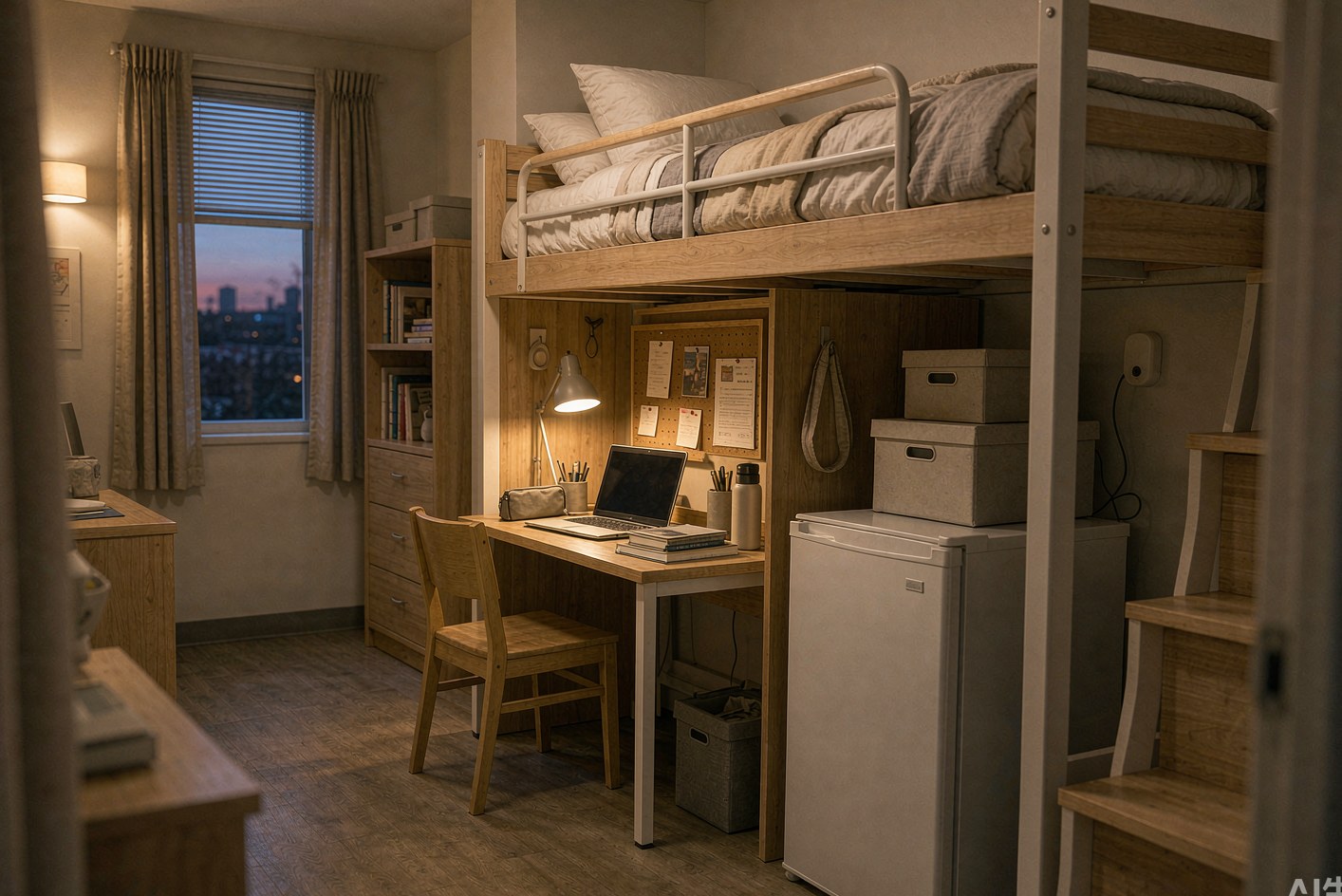
A dorm room is not a small apartment. You don't own the building, you can't touch the mechanical systems, and you usually can't even change the batteries in the device on the ceiling without filing a work order. That changes the carbon monoxide problem in a specific way: most of the standard advice — install this, hardwire that, service your furnace annually — is advice you are not permitted to follow.
What's left is still useful. You can refuse to create CO inside your own room, you can learn to recognise the building-level sources that nobody explains during orientation, and you can put a live readout where you can actually see it. This guide covers all three, plus the awkward part nobody mentions: your roommate's choices are part of your risk, and you can't control them either.
Why a dorm room is a different CO problem
Four structural things separate student housing from a normal residence.
You don't control the combustion equipment. In a house, the furnace, water heater, and stove are yours; you choose when they're serviced and whether they're replaced. In a residence hall, the boiler that heats your building and the system that feeds your shower belong to the institution. You can't inspect them. You can only notice symptoms and report them.
The building is shared, and so is the air. Most dorms have corridors, stairwells, trash rooms, lounge kitchens, and sometimes a connected parking structure. Air moves between these spaces and your room through door undercuts, HVAC returns, and open windows. A source that isn't in your room can still reach your room. Our guide to rental situations covers the same dynamic in apartments: Apartment CO Detector Laws.
The volume is tiny and the envelope is sealed. A double room is often 150–220 square feet with a single operable window that most students keep shut ten months of the year. Small volume means less dilution; closed windows mean less fresh air. Both work against you.
Everyone sleeps at the same time. Eight hours of unconscious exposure is the scenario CO incidents are built around, and a hall full of students sleeping through it is exactly that.
Where CO actually comes from in student housing
Most dorm CO guidance stops at "don't bring a grill inside." That's correct but incomplete. Here's the fuller list, ordered by how often it actually matters.
1. The building's own boiler and hot water system
This is the source students never think about, because it's the one they can't see. Campus heating plants and in-building boilers run hard during the first cold snap and the last one, and older systems in older buildings are the ones most likely to have a degraded heat exchanger or a partially blocked flue.
What this looks like from a student's perspective is not dramatic. It's a room that reads a low but non-zero number on a display, or a persistent faint exhaust smell in a stairwell, or hot water that behaves oddly. None of those are things you can fix. All of them are things you can report, and reporting is genuinely the correct action — facilities departments do act on CO complaints.
If your building has a boiler room on the ground floor or below grade, and your room is directly above it, that's worth knowing. The same vertical relationship that matters in a house matters here: Basement CO Alarms.
2. Banned heating and cooking devices
This is the category that produces actual student-housing incidents, and it deserves precision rather than a blanket warning.
Electric resistance heaters produce no CO at all. A plug-in electric space heater, an electric blanket, a heating pad — these have no combustion, so they cannot generate carbon monoxide. They have other fire risks, which is why many schools ban them anyway, but CO is not one of them.
What does produce CO is anything that burns fuel indoors:
- Butane and propane camping stoves, including the small single-burner type sold for backpacking
- Kerosene or fuel-burning portable heaters
- Charcoal grills, including the small "hibachi" style
- Camping lanterns that burn fuel rather than using LEDs
- Portable generators, which produce enormous amounts of CO and kill people indoors every year
These are banned in essentially every residence hall in the country, and the ban is not bureaucratic fussiness. A single butane burner running for ten minutes in a 180 sq ft room with the window shut can push a room from background to a reading you would not want to sleep through. Our full breakdown of the heater question is here: Space Heater Carbon Monoxide Risk.
The hard part is that these are usually your roommate's, not yours. More on that below.
3. Candles, incense, and "it's just a flame"
A candle does produce a small amount of CO through incomplete combustion. In a normal room, that amount is negligible — you will not poison yourself with a candle in a ventilated space. The realistic risk from candles and incense is fire, not CO.
Where it becomes a CO-adjacent question is quantity and confinement. Twenty candles in a sealed 150 sq ft room with the window closed is a different situation from one candle on a desk. And a display monitor will show you the cumulative effect of smoke and combustion byproducts in the room, which is useful information even when the number stays low.
4. Attached or connected parking structures
Some student housing sits directly above or beside a parking garage, a loading dock, or a ground-level service bay. Vehicle exhaust is high in CO, and it migrates. If your room is on the second or third floor above a garage entrance, and you notice the reading climbs in the morning or late afternoon — matching commute patterns — that is a plausible building-envelope issue worth a work order.
5. Generators and storm outages
Campus emergency generators are professionally installed and vented. The risk is the portable generator somebody brings out during an extended outage and places near a window, in a stairwell, or — in real incidents — inside a ground-floor lounge to keep a fridge running. Generators must be well away from the building with exhaust pointed away from every opening. Full distance rules: Generator Carbon Monoxide Safety.
6. Common-area kitchens and lounges
Floor lounges with gas ranges, shared kitchens, and even a neglected fireplace in a common room are building-level sources. If your room shares a wall or a return air path with one, you inherit some of it.
What your school already has — and what it doesn't
Most US residence halls have smoke alarms in sleeping rooms and a CO detection strategy at the building level. The specifics depend on state law and which fire code the campus adopted, and coverage inside individual dorm units varies more than students assume.
Two things matter regardless of what's installed:
A code-required alarm is designed to stay quiet at low levels. Under UL 2034, an alarm must not sound below 30 ppm, and it is permitted to delay for a long time in the 51–69 ppm band. This isn't a flaw — it's deliberate, to keep alarms from sounding during ordinary cooking. But it means a real, measurable amount of CO can be present in your room without the building's alarm making a sound. The full threshold table is in UL 2034 Explained.
You don't know the age of the device on your ceiling, and you can't check. Sensor drift is silent. A unit past its service life still powers on and still looks fine. In your own home you'd write the install date on a sticker. Here, you can ask housing for the replacement cycle, and that's a reasonable question to ask. Background: How Long CO Detectors Last.
None of this is an argument that the building system is inadequate. It's an argument that the building system is designed to do one job — alert loudly at a defined threshold — and "show me what the air is doing right now" is a different job.
What you can actually control
Five things, in order of impact.
1. Ask housing what's permitted, in writing. Before you bring anything that plugs in and monitors, check your housing contract. Some schools restrict devices with heating elements or open flames; a plug-in monitor generally doesn't fall into those categories, but the answer costs you one email and removes all ambiguity. This is the single most-recommended step and the one most students skip.
2. Don't create a source. No fuel-burning anything inside. No charcoal, no butane, no kerosene, no generator. If you want hot food, use the floor kitchen or a school-approved electric appliance.
3. Put a live readout where you'll see it. A plug-in unit with a digital display gives you the one thing the ceiling device can't: the number, continuously, in a form you can watch change. Plug-in also matters in a dorm specifically — no wiring, no mounting holes, no deposit dispute at move-out. The tradeoffs between plug-in and battery units are covered here: Plug-In vs Battery CO Detectors. If you want the short version of what that looks like in practice, see the HD16.
4. Learn the reporting path before you need it. Find the facilities emergency number, save it, and write down where it is. At 2 a.m. with a display showing a climbing number, you do not want to be searching a website.
5. Have the roommate conversation early. Not as an accusation — as a practical agreement. "No fuel-burning stuff in here, and if the number on that thing goes up we open the window and call facilities." Two minutes in September prevents an argument in February.
Placement in a 150 sq ft room
Small rooms make placement both easier and easier to get wrong.
- Breathing-zone height, not the ceiling and not the floor. CO mixes with air rather than pooling, so you want the unit where your head actually is — desk height or slightly above. Our detailed placement guide: CO Detector Placement Height.
- Not inside the closet, under the bed, or behind the mini fridge. These are the three most common dorm placements and all three are dead-air pockets. A unit in a closed closet measures the closet.
- Away from the window and away from the HVAC vent. One gives you outdoor air instead of room air; the other gives you supply air instead of mixed room air.
- Where you'll actually glance at it. Near the door, next to the desk, somewhere in your natural sightline. A monitor you never look at provides no information.
- Not blocked by curtains, posters, or a bed pushed against it.
Given how small dorm rooms are, one properly placed unit covers the space. This is not a case for buying three. If you're weighing options, here's the HD16.
How to read the number
If your monitor displays a live ppm value, here's a practical interpretation for a dorm context. Treat this as a decision guide, not a medical or regulatory standard.
| Reading | What it usually means | What to do |
|---|---|---|
| 0–9 ppm | Normal indoor background | Nothing. This is what an occupied room looks like. |
| 10–29 ppm | Low but real; often from a nearby source | Open a window, note the time, watch whether it clears. If it recurs daily, file a work order. |
| 30–50 ppm | Meaningful; still below mandatory alarm response | Ventilate, step out, call facilities. Do not sleep through it. |
| 51+ ppm | Into the range where alarms respond, with permitted delays | Leave the room, call facilities/emergency, don't re-enter until cleared. |
| Any reading + symptoms | Headache, nausea, dizziness, unusual sleepiness | Leave immediately, get fresh air, seek medical attention, report it. |
For the full explanation of why these bands exist and what the standard requires at each one: Safe CO ppm Levels: What the Numbers Mean. A display that refreshes every couple of seconds is what turns that table into something you can actually watch — the HD16 shows it live.
The pattern matters more than any single number. A room that reads 8 ppm every afternoon at 4 p.m. is telling you something a code-compliant alarm will never tell you, because 8 ppm is far below anything it's allowed to respond to. That's the entire case for a display.
When it beeps — and when it's not actually CO
Two different events get confused constantly.
A low-battery or end-of-life chirp is a short periodic beep, often at night when the room is coolest. It's maintenance, not a gas event. Our troubleshooting guide: Why Your CO Detector Is Beeping.
A number that climbs and stays up is information, not an alarm. Ventilate, identify the source, report it.
A full alarm is four loud repeating tones. Leave, then call. Don't investigate first.
It's also worth knowing what else can nudge a reading upward so you don't chase ghosts — cleaning sprays, some paints and solvents, and high humidity can all affect sensors. Full list: CO Detector False Alarm Causes. And if your unit also reports temperature and humidity, that second reading is genuinely useful for diagnosing why the first one moved: CO Detectors With Temperature and Humidity.
A short dorm checklist
- Email housing and confirm what devices are permitted.
- No fuel-burning anything in the room — charcoal, butane, kerosene, generators.
- One code-compliant alarm is the building's job; confirm coverage for your unit with housing.
- One plug-in display monitor at desk height, in open air, in your sightline.
- Save the facilities emergency number before you need it.
- Agree with your roommate on the no-combustion rule and what you'll do if a number climbs.
- Note the install date of anything you bring, and replace on the manufacturer's schedule.
- Report recurring low readings. You are the only sensor the facilities department has inside your room.
Want a live readout you can actually watch? See the HD16 and the full spec
FAQ
Do dorms have carbon monoxide detectors?
Most US residence halls have smoke alarms in sleeping rooms and CO detection at some building level, but whether there's a unit inside your specific room depends on state law and the fire code your campus adopted. Ask your housing office directly — it's a reasonable question and they'll answer it.
Can I bring my own detector to a dorm?
Usually yes for a plug-in unit with no open flame and no heating element, but policies vary and some housing contracts restrict devices. One email to housing removes all doubt. Don't mount anything to walls or ceilings, and don't remove or cover the building's alarm.
Is an electric space heater a CO risk?
No. Electric resistance heat has no combustion and produces no carbon monoxide. Schools may still ban electric heaters for fire-load reasons, but CO is not the concern. Fuel-burning heaters are the CO concern.
My roommate brought a camping stove. Is that actually dangerous?
Yes, indoors. A butane or propane burner in a sealed 150 sq ft room can raise CO measurably in minutes. This is banned by essentially every housing policy for a real reason. If a conversation doesn't resolve it, that's what an RA is for.
Why would my monitor show a number if the building alarm never goes off?
Because the building alarm is required to stay silent below 30 ppm and may delay substantially up to 69 ppm. A reading of 15 or 25 ppm is real information that a compliant alarm is specifically designed not to act on. Both devices are behaving correctly; they're doing different jobs.
Where should I put it if I have a lofted bed?
On or near the desk, at roughly the height your head is when you're sitting or sleeping up there — not on the floor under the loft, and not pinned against the ceiling. You're measuring the air you breathe.
What should I do if it alarms at 2 a.m.?
Leave the room, wake your roommate, get to fresh air, and call the facilities emergency number or campus safety. Do not open windows and go back to sleep, and do not try to find the source yourself. Let the professionals clear the space.
Does a CO monitor also cover gas leaks?
Not automatically. Carbon monoxide is a combustion product; a leaking unburned gas is a different hazard that needs a combustible gas sensor. If your building has gas service and you want both layers, read Do You Need a Gas Detector in Your House?. And for the distinction between smoke and CO detection, see Smoke Detector vs Carbon Monoxide Detector.
How long will a unit last before I need to replace it?
Electrochemical CO sensors have a finite service life, commonly around five years, and sensitivity drifts down quietly rather than failing loudly. Write the install date on it. Details: How Long CO Detectors Last.
*VASAIKO builds supplemental CO monitors with live digital readouts — the layer that shows you what a code-compliant alarm is required to keep silent. They do not replace the CO alarm your building requires.*