
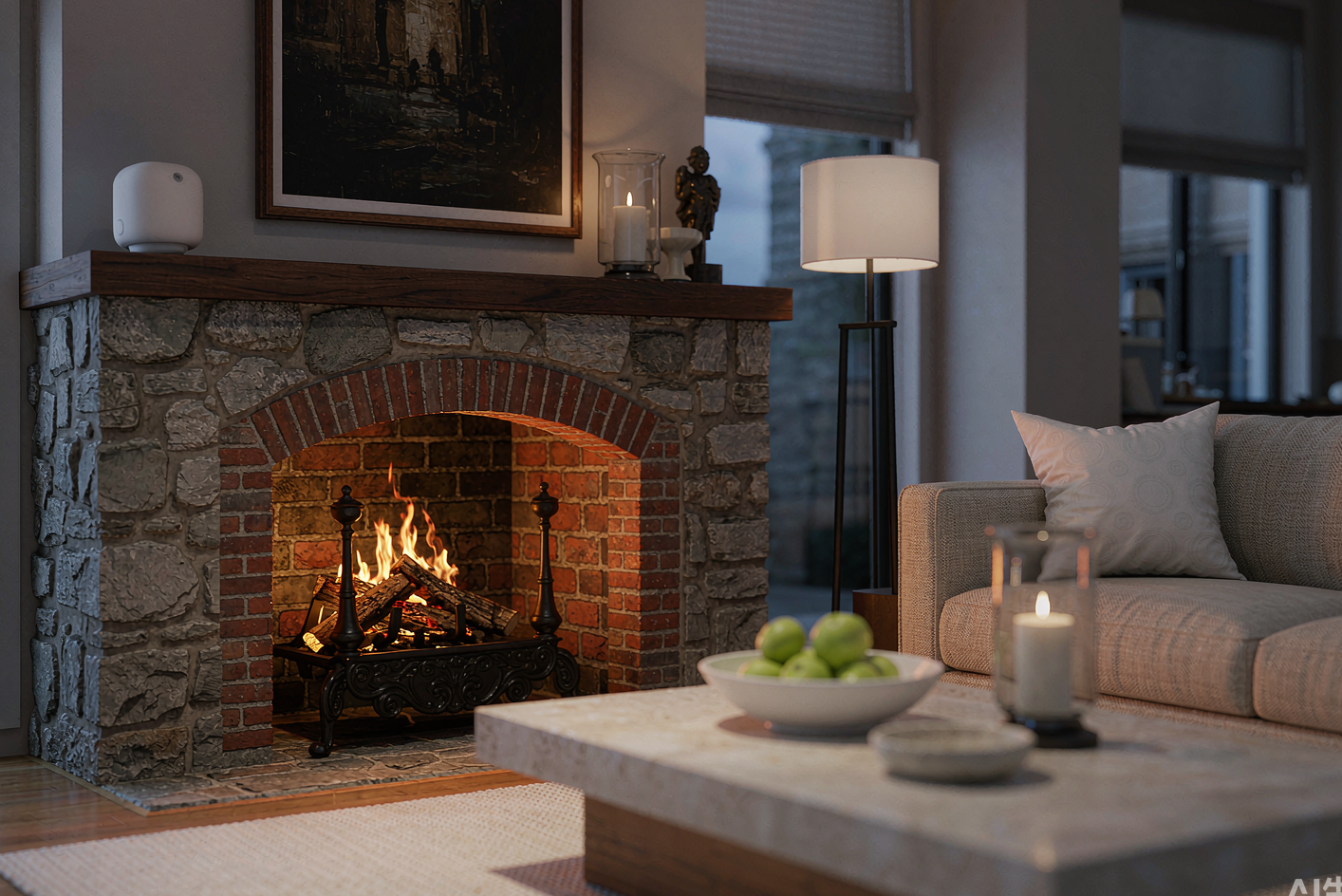
A crackling fire makes a room feel safe. That is exactly why fireplaces are one of the most misunderstood carbon monoxide risks in a home — the source of the danger sits in the middle of the room where the family gathers, and the alarm that should catch it is often mounted in the wrong place or not mounted at all.
This guide covers where a fireplace carbon monoxide detector actually belongs, why the obvious spot (right above the mantel) is the wrong one, and how wood-burning and gas fireplaces create two different risk profiles.
Why fireplaces produce carbon monoxide
Carbon monoxide is a byproduct of incomplete combustion. Any time a carbon-based fuel burns without enough oxygen, CO is produced instead of carbon dioxide. A fireplace is an open combustion appliance, which means it is far less controlled than a sealed furnace.
The conditions that push a fireplace from "normal" into "dangerous":
- A closed or partially blocked damper or flue. If combustion gases cannot exit, pressure reverses and they spill into the room.
- Creosote buildup. Wood smoke deposits a tar-like residue inside the chimney. Accumulation narrows the flue and reduces draft, and creosote itself is a fire hazard.
- Cold chimney / weak draft. On mild days, or when the fire is first lit, the temperature difference between inside and outside the flue may be too small to create enough upward draft.
- Negative house pressure. Running a kitchen exhaust fan, a bathroom fan, or a clothes dryer while a fire is burning can pull air *down* the chimney instead of up it. This is the single most preventable cause of fireplace-related CO incidents.
- Unseasoned (wet) wood. High moisture content lowers combustion temperature and produces substantially more CO and creosote per hour of burn.
- Downdraft from wind. Certain rooflines and nearby trees create pressure zones that push exhaust back into the flue.
None of these produce a smell. CO is odorless, colorless, and non-irritating — you will not cough, and your eyes will not water. The first indicator is usually a symptom, which is why detection has to be mechanical rather than sensory.
The mantel mistake: why you should not mount it right above the fire
The most common instinct is to put the alarm directly above the fireplace. It is visible, it is near the source, and it seems logical. It is also the placement most likely to fail you in two opposite ways at once.
1. Heat, soot, and smoke cause false alarms. Mounting directly above the flue exposes the sensor to intermittent smoke and elevated temperature every time you light a fire or add a log. Electrochemical CO sensors are designed to respond to CO, but heavy smoke exposure accelerates sensor drift and will generate nuisance alarms — which trains the household to ignore or remove the alarm. Our guide to the most common CO detector false alarm causes covers this failure pattern in detail.
2. The rising plume does not travel where you think. Directly above a fireplace, hot combustion gases rise straight up the flue. The air immediately above the mantel is often a *dead zone* — gas climbs the chimney, not across the ceiling. Meanwhile, the CO that does enter the room does so in a spillage layer near the ceiling that spreads outward and mixes with room air before it ever reaches the mantel face.
In other words: mounting over the mantel puts the sensor where the smoke is but the CO plume is not, while simultaneously degrading the sensor.
The distance rule
Place the alarm 10 to 20 feet away from the fireplace, mounted on the wall or ceiling of the same room. This range is far enough to avoid heat and smoke contamination, and close enough to catch a spillage event within minutes rather than tens of minutes.
| Placement | Recommendation | Why |
|---|---|---|
| Directly above the mantel | Avoid | Smoke and heat degrade the sensor; the area is an airflow dead zone |
| On the mantel shelf | Acceptable if ≥ 5 ft above the firebox and ≥ 10 ft is not possible | Better than directly above, still exposed to heat |
| 10–20 ft away, same room, wall-mounted | Best | Avoids contamination while catching ceiling-layer spillage |
| Ceiling-mounted in the room | Good alternative | CO rises with warm air and collects near the ceiling |
| Hallway outside the room | Insufficient alone | Doors and distance delay detection |
| Inside the chimney/flue | Never | Physically impossible and destroys the unit |
Because CO mixes with warm rising air rather than pooling at the floor, mounting height matters less than most people assume — but there is still a defensible standard. We break down the evidence and the practical rule in CO detector placement height: how high is high enough.
Wood-burning vs. gas fireplaces: two different risk profiles
These two appliances are frequently treated as equivalent. They are not.
Wood-burning fireplaces
The dominant risk is incomplete combustion plus flue obstruction. Wood smoke contains CO continuously, and the risk scales with:
- Wood moisture content (seasoned = under 20% moisture, typically dried 6–12 months)
- Fire size relative to flue capacity
- Chimney condition and time since last inspection
Wood fires also produce particulate matter (PM2.5), which is a respiratory hazard independent of CO. If your alarm is a combination smoke + CO unit, expect it to respond to smoke from a wood fire more often than a gas unit would — another reason for the 10–20 ft separation.
Gas fireplaces
Gas fireplaces burn cleaner, but they introduce a hazard wood fireplaces do not: fuel gas leaking before ignition. A gas log set with a standing pilot, or a faulty valve, can release natural gas or propane regardless of whether combustion is happening.
This is the case where a CO-only alarm leaves a genuine gap. A combination CO and combustible-gas detector covers both failure modes — incomplete combustion after ignition, and unburned gas before ignition. If you have a gas fireplace, read our combination CO and gas detector buying guide and our dedicated home gas leak detector explainer before choosing a unit.
If your gas appliance is propane-fueled, note that propane is heavier than air and settles low — the opposite behavior from CO. That difference is covered in propane detection for RVs, and the same physics applies to a propane fireplace in a basement or a room with a floor-level gas line.
Symptoms and concentration: what the alarm is actually protecting you from
CO binds to hemoglobin roughly 200+ times more readily than oxygen, forming carboxyhemoglobin and starving tissues of oxygen. Early symptoms are nonspecific and are routinely mistaken for flu or food poisoning:
- Dull headache (most common early sign)
- Dizziness or lightheadedness
- Nausea without vomiting
- Confusion or difficulty concentrating
- Weakness, particularly on exertion
The clinical danger is that CO impairs judgment *before* it causes pain. A person with rising CO exposure may not recognize that something is wrong or may be unable to act on it — which is precisely why the alarm, not the occupant, has to be the thing that detects the event.
For the full concentration-to-effect table, including the exposure limits used by safety standards and what the alarm thresholds mean, see safe CO ppm levels explained.
Installation checklist for a fireplace room
- Mount 10–20 ft from the firebox, on a wall or the ceiling of the same room.
- Never place it inside or adjacent to the flue, and avoid the dead-air zone directly above the mantel.
- Keep it out of corners and away from windows, doors, and supply vents where airflow dilutes or bypasses the sensor.
- Add a second alarm in the adjacent sleeping area. If a fire smolders overnight, you need detection between the source and the people. The basement CO alarm guide explains why single-point coverage fails in multi-level homes.
- Do not run exhaust fans while a fire is burning. Kitchen hoods and bathroom fans can reverse chimney draft within minutes.
- Choose plug-in with battery backup for a fireplace room. Fireplaces are used seasonally and are often in rooms where nobody will notice a depleted battery for months. Our plug-in vs. battery comparison lays out the tradeoff.
- Test monthly, replace on schedule. Electrochemical sensors drift and have a finite service life regardless of whether the unit has ever alarmed. Replacement intervals are covered in how long CO detectors last.
Need one unit that satisfies items 1 through 7 without compromises? See the VASAIKO HD16 6-in-1 smart safety detector →
A CO alarm is not a substitute for a smoke alarm, and the reverse is also true. They respond to different byproducts of different failures. If you are unsure which is doing what in your home, start with smoke detector vs. carbon monoxide detector.
Prevention beats detection
Detection is the last line of defense. The higher-leverage interventions are upstream:
- Annual chimney inspection and cleaning by a certified sweep, before the burning season.
- Burn seasoned hardwood with moisture content under 20%.
- Open the damper fully and verify draft before lighting (hold a lit match near the firebox — the flame should pull inward).
- Crack a window in the room during startup on mild days to support draft and offset negative pressure.
- Never use a wood fireplace as a primary heat source while sleeping.
- Do not burn treated lumber, painted wood, plywood, or household trash.
If a fire is your backup heating plan during a power outage, the generator sitting outside is a second CO source with a very different placement requirement — covered in generator carbon monoxide safety.
Detection closes the gap that prevention cannot. A unit with plug-in power and built-in battery backup keeps protecting you through the outage that sent you to the fireplace in the first place — explore the VASAIKO HD16 →
Choosing a detector for a fireplace room
Three specifications matter more than the rest for this specific use case:
1. Multi-gas coverage. If the fireplace is gas-fueled, a CO-only unit leaves the pre-ignition leak uncovered. A 6-in-1 unit that monitors CO, combustible gas, smoke, temperature, and humidity closes both gaps and gives you the temperature and humidity readout that indicates whether the room's combustion environment is changing.
2. Power resilience. A plug-in unit with a built-in battery backup keeps working through the outage that most often coincides with fireplace use. A battery-only unit has no way to signal a depleted cell until it chirps.
3. Placement flexibility. Magnetic mounting or a swappable mount means you can move the unit seasonally — closer to the fireplace room in winter, back to a hallway or garage in the off-season — without tools or new hardware. The same flexibility matters for attached garages, which share the vehicle-exhaust CO profile.
The VASAIKO HD16 is a 6-in-1 smart detector built for exactly this: CO, combustible gas, and smoke sensing with an integrated temperature and humidity display, plug-in power with built-in battery backup, and magnetic mounting that lets you reposition it by season. It is tested to UL 2034, UL 1484, and UL 217 standards, CE & FCC Certified, and RoHS Compliant.
Learn more about the VASAIKO HD16 6-in-1 smart safety detector →
Frequently asked questions
Can I put a carbon monoxide detector above my fireplace?
It is not recommended. Directly above the mantel, the sensor is exposed to heat, smoke, and soot that cause false alarms and accelerate sensor drift — while the rising plume means that spot is often an airflow dead zone. Aim for 10–20 ft away in the same room.
How far from a fireplace should a CO detector be?
Ten to twenty feet works for most rooms. Closer than about 10 ft risks nuisance alarms from smoke; farther than 20 ft delays detection of a spillage event.
Do gas fireplaces produce carbon monoxide?
Yes. Any combustion appliance produces CO when combustion is incomplete. Gas fireplaces add a second risk: unburned gas leaking from the valve or pilot before ignition, which a CO-only alarm will not detect.
Will my fireplace cause false CO alarms?
It can, if the alarm is mounted too close or if the chimney has draft problems. Persistent alarms while burning are a signal to check draft and flue condition — not to remove the batteries.
Does a CO detector also detect smoke?
Only if it is a combination unit. A CO-only alarm will not respond to smoke, and a smoke-only alarm will not respond to CO. Both failure modes exist in a room with a fireplace.
Should the alarm be in the same room as the fireplace or in the hallway?
Both. One in the fireplace room catches the event at the source; one in or near the sleeping area protects occupants whose doors are closed.
The bottom line
A fireplace is a combustion appliance operating in your living space. Installing a CO detector is straightforward; installing it in the right place is what actually protects you. Keep it 10–20 ft from the firebox, keep it out of the smoke plume, add a second unit near sleeping areas, and service the chimney annually.
For a detector that covers CO, combustible gas, and smoke in one unit — with the plug-in reliability and battery backup a fireplace room needs — see the VASAIKO HD16 6-in-1 smart safety detector.
*Not sure whether an existing unit is still within its service life? Check the manufacture date with our guide on how long CO detectors last.*