
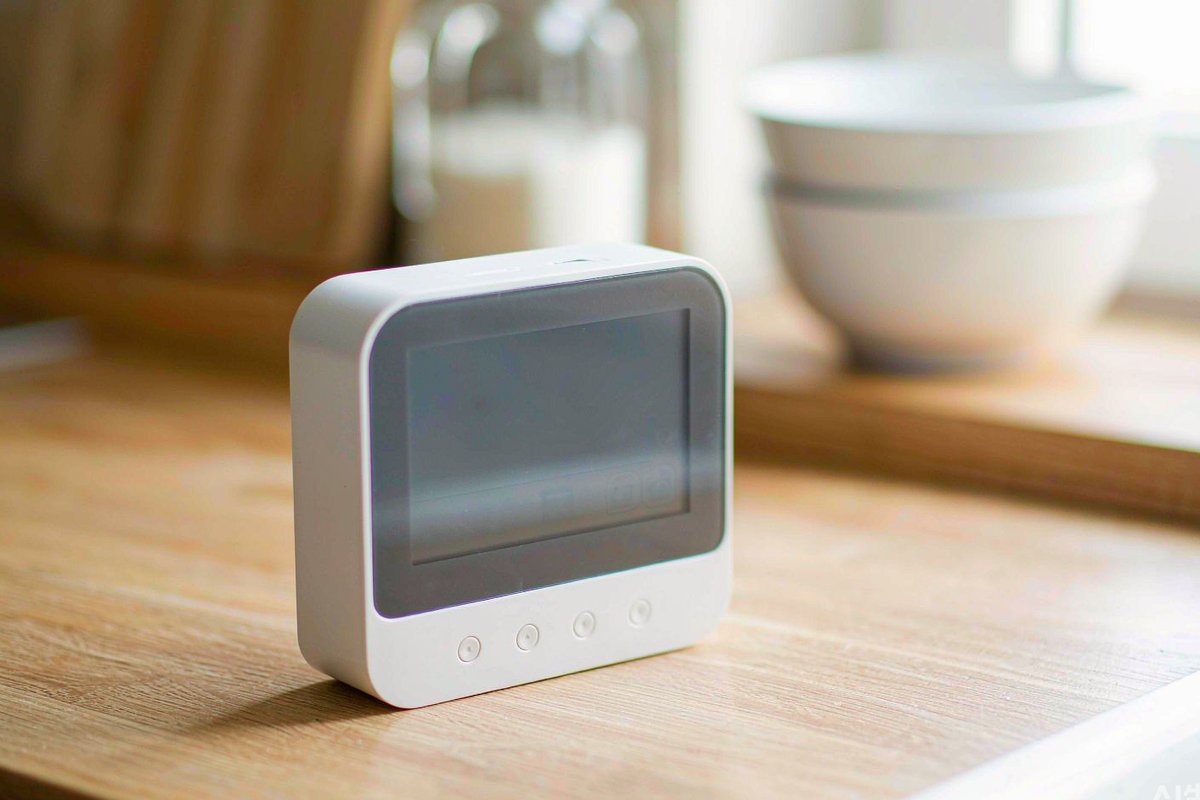
A standard carbon monoxide alarm has exactly two states: silence and panic. It stays quiet for years, then it screams at three in the morning, and you have no idea whether you are looking at a real emergency, a burnt dinner, or a unit that simply reached the end of its life. A carbon monoxide detector with a digital display adds a third state — information. It shows you the number, not just the noise.
That difference sounds cosmetic until the first time you actually need it. This guide covers what a readout really tells you, how to interpret ppm trends rather than single numbers, what to check before you buy a display unit, and where a plug-in readable monitor earns its keep in a real home.
What "Digital Display" Actually Means on a CO Detector
There are three things manufacturers loosely call a display, and they are not the same product. Knowing which one you are buying prevents most buyer's remorse.
| Type | What you see | Sold as | Typical position |
|---|---|---|---|
| Status indicator only | LED colours: green = normal, amber = fault, red = alarm | "CO alarm with indicator light" | Ceiling or wall |
| Digital readout | Live numeric ppm value (e.g. 0, 12, 45, 120) plus units | "CO detector with digital display / ppm readout" | Plug-in at outlet height, or tabletop |
| Full smart panel | ppm + other readings in one view (combustible gas, smoke, temperature, humidity, battery state) | "Multi-gas monitor / 6-in-1 detector" | Tabletop or plug-in, moved as needed |
If your main goal is knowing whether carbon monoxide is present *right now, and how much*, the second row is the honest minimum. The third row — the category VASAIKO builds — simply puts more of the same kind of information on one screen so you are not juggling three devices.
The important part is that a display shows parts per million (ppm), which is the unit every safety threshold in the United States is written in. If you want the full ppm reference including time-weighted limits, read our safe CO ppm levels chart.
Why a Live Number Changes the Decision
Consider three situations that are indistinguishable to a beeping alarm.
Case 1 — The 3 a.m. alarm. The hallway unit goes off. With a beep-only alarm, you evacuate or you don't; you cannot tell whether the hallway genuinely has CO in it. With a readable unit that also handles false alarm causes gracefully, you can check whether the number is climbing, holding, or flat at zero after you ventilate the room. That does not replace emergency response — if anyone has symptoms, you leave and call for help, full stop. It does replace twenty minutes of guessing.
Case 2 — The slow appliance problem. A water heater with a partially blocked flue does not produce one dramatic spike. It produces a low reading every time the burner fires, week after week. That is precisely the failure mode covered in water heater carbon monoxide risk, and it is invisible to an alarm that only wakes up at a fixed threshold.
Case 3 — The "is it done yet?" question. After you air out a garage after running a car, or after a generator runs too close to the house, you want confirmation that the number came back down. A display gives you closure. A silent alarm only tells you it hasn't crossed its trip point.
In all three cases the readout is not replacing the alarm. It is answering the question the alarm cannot: *how much, and is it getting better or worse?*
How to Read a ppm Display Without Overthinking It
Two rules cover 95% of real-world reading.
Rule one: read the trend, not the instant. A car idling just outside an attached garage can push a hallway reading up temporarily, then it falls back. What matters is whether the value is settling back to its normal baseline. For a practical map of what low/medium/high ranges mean and how long exposure matters, see safe CO ppm levels chart and carbon monoxide poisoning symptoms.
Rule two: know your baseline. In most homes the resting number is zero, or it hovers in the low single digits near a kitchen or an attached garage door. Write down what "normal" looks like on a quiet Tuesday. Everything after that is a comparison, not a chemistry exam.
A few things to keep in perspective:
- A displayed value is a spot check, not a lab result. Consumer electrochemical sensors are specified with a tolerance; VASAIKO's HD16, for example, is specified at ±5% across a 0–999 ppm range. Small single-digit movement is noise.
- Refresh rate is not response time. A unit advertised with a 2-second refresh updates its screen every two seconds; how quickly the sensor chemistry reacts to a change is a separate specification. Both matter, and honest spec sheets list them separately.
- Warm-up is real. Most electrochemical sensors need a short stabilisation period (roughly a minute on the HD16) before the first reading is trustworthy. If you plug it in and immediately see a nonzero number, wait, then judge.
- Displays can also be wrong in a useful direction. A unit that reads
0while people feel unwell should not reassure anyone. Symptoms outrank instruments every time — see carbon monoxide poisoning symptoms.
The Peak Reading Feature Is Underrated
The single most useful function on a display unit is not the live number. It is the recorded peak — the highest concentration the device saw since you last reset it.
Why it matters: carbon monoxide events are often *intermittent and unattended*. The furnace spikes during the 6 a.m. cycle while everyone is asleep. The fireplace back-drafts for a few minutes when the damper is cold. A space heater cycles in a closed room in the evening. None of these necessarily crosses an alarm threshold, and none of them is happening while you are staring at the screen.
A stored peak converts those invisible forty minutes into a number you can read in the morning, and into evidence you can hand to an HVAC technician. If you are choosing between two otherwise similar units, prefer the one with peak recall.
If you would rather not think about that feature separately, the VASAIKO HD16 keeps the live value and the tracked maximum on the same screen, so the morning check takes two seconds.
Where to Put a Unit You Actually Want to Read
Placement guidance for CO devices splits in two, and display units change the answer.
Conventional required alarms go where the code says — typically near sleeping areas and on each level. Our dedicated guide on CO detector placement height walks through why CO behaves differently from smoke, and why you may want more than the minimum count discussed in how many CO detectors you need.
A readable monitor has one additional constraint: put it where you can see it. Nobody crouches to read a ceiling unit. Useful positions tend to be:
- Kitchen counter or shelf, away from the stove and cooking aerosols, where you glance at it while making coffee — useful given that a kitchen is a realistic source, covered in kitchen gas leak alarms.
- Near the door to an attached garage, which is the highest-value spot in most houses; the reasoning is laid out in CO alarms for attached garages.
- Mechanical room or nearby hallway, so that a furnace or boiler problem shows up early rather than as a service call in January.
- Basement stairwell, including in finished basements used as living space.
- Nightstand when travelling. Portability is the underrated benefit — see RV carbon monoxide detection and CO detectors on boats for situations where the "unit" is a vehicle rather than a room.
If you want the deeper power argument — continuous mains versus portable cells — the trade-off is spelled out in plug-in vs battery CO detectors. The practical middle ground most people end up wanting is a plug-in unit with battery backup, which stays at mains power normally and keeps running for roughly eight hours when the power drops out.
Rentals, Dorms and Small Spaces
Readable units solve a specific problem in housing you do not control: you often cannot install anything permanent, and you cannot audit what the landlord already installed.
In a rental, the code-compliant alarm is the landlord's responsibility in most jurisdictions — the boundaries are summarised in apartment CO detector law. Adding a plug-in readable unit does not interfere with that requirement and does not require drilling. It simply gives you visibility you can take with you when you move.
In a dorm or shared flat, the same logic applies harder: you cannot modify the room, and you may not know the age or test status of what is on the ceiling. A tabletop monitor with its own reading is self-contained — see dorm CO safety for the specifics.
In very small footprints — tiny houses, camper conversions, micro-cabins — one readable unit often replaces the "Is that smell anything?" anxiety entirely, because the whole dwelling is within a few metres of the detector. The volume, airflow and appliance-proximity arguments are covered in tiny house CO detectors.
The pattern across all three: a display unit is the only kind of CO protection that travels with you rather than staying with the building. For households that move often, that alone can justify the purchase.
Browse the VASAIKO HD16 6-in-1 detector to see the plug-in format.
Buyer's Checklist for a Display Unit
Skip the marketing adjectives and check these seven things instead. The first two decide whether the device fits your situation at all.
| # | Check | Why it matters |
|---|---|---|
| 1 | Plug-in with genuine battery backup, or pure battery? | Determines whether it can sit in one place permanently or needs charging discipline. See plug-in vs battery. |
| 2 | CO only, or CO + combustible gas / smoke? | If your concern includes gas appliances beyond CO, compare options in do you need a gas detector and the combination CO and gas buying guide. |
| 3 | Stated ppm range and accuracy | Look for a real range and tolerance (for example 0–999 ppm at ±5%), not just "detects CO". |
| 4 | Refresh cadence and warm-up time | A 2-second refresh and roughly 60-second warm-up are practical, honest figures. |
| 5 | Peak-memory and reset | Stores events that happen while you are asleep. High value, easy to overlook. |
| 6 | What else is on the screen? | Additional readings turn one purchase into a general air monitor — see CO detector with temperature and humidity. |
| 7 | Stated compliance and end-of-life handling | Look for "tested to UL 2034 / UL 1484 / UL 217 standards", "CE & FCC Certified", "RoHS Compliant". Then check how long CO detectors last before assuming it is a buy-once item. |
One caution worth stating plainly: a detectable smell of gas, a hissing sound, or symptoms in the household are all "act now" signals, regardless of what any screen says.
What a Display Unit Is Not
This is the part most marketing copy leaves out, and it matters more than any feature.
It is not a substitute for the alarms your home is required to have. A readable monitor is best understood as a supplemental layer: it gives you visibility, which your main alarms do not. Landlords and homeowners should still meet whatever applies to their situation — the legal framing is summarised in apartment CO detector law, and the standard itself is explained in plain language in UL 2034 explained. It also does not replace a smoke alarm; the two senses are different problems, compared in smoke detector vs carbon monoxide detector.
It needs regular verification. A display that has been quietly drifting will still show numbers, confidently. Put your units into a monthly test habit using the procedure in how to test a carbon monoxide detector, and learn the difference between alarm, fault, and end-of-life signals so you are not decoding chirps under pressure — covered in why your CO detector is beeping.
It has a service life. Electrochemical sensors age. Expect roughly five years of useful sensor life on a typical unit and plan replacement accordingly, per how long CO detectors last.
Putting a Readable Unit to Work
If you take nothing else from this article, take this sequence:
- Establish the baseline. Week one: note what the number settles at in each spot you care about.
- Watch for changes, not absolutes. A persistent shift away from baseline deserves attention even if the value looks small.
- Check the peak weekly. Once a week, glance at the stored maximum. That is where invisible events live.
- Test monthly. Button test plus a visual check that the display is plausible.
- Log replacement year. Put it in your phone now, not later.
See the VASAIKO HD16 6-in-1 detector if you want one plug-in unit that combines live CO ppm with combustible gas, smoke, temperature, humidity, and battery state on a single screen, with roughly eight hours of battery backup.
Four Mistakes People Make With a Display Unit
Treating every nonzero number as an emergency. Displays are honest, which is their problem as well as their virtue. A brief reading after the oven is lit, or after a car pulls into an attached garage, is a real event and also a short one. Ventilate, note whether it falls, and watch the trend.
Reading the screen instead of testing the unit. A display is not a self-test. A device can show numbers and still fail an audible test. Keep the monthly routine in how to test a carbon monoxide detector and treat chirp patterns as signals, using why your CO detector is beeping to decode them.
Installing it permanently in the wrong room. The best readable unit is one you walk past every day. If it lives in a cupboard "where it won't be in the way", it becomes a beep-only alarm with extra steps. Revisit placement with CO detector placement height.
Assuming it never expires. Electrochemical sensors drift and then stop. Roughly five years is the practical planning figure; confirm the replacement interval for your model and write it down, as covered in how long CO detectors last.
Avoid those four and a display unit does exactly what it should: turn carbon monoxide from an invisible binary into something you can watch.
FAQ
Does a CO detector with a display go off louder than a regular one?
No. Audible alarm patterns are set by the same product standards — see UL 2034 explained. The display adds information; it doesn't change the siren.
What number should a carbon monoxide detector read normally?
Zero in most rooms. Low single digits can appear near kitchens, attached garage doors, or on first warm-up. Anything sustained should prompt ventilation and investigation. Ranges and exposure times are laid out in our safe CO ppm levels chart.
Can I use a plug-in display unit as my only detector?
Generally not. Treat it as a supplemental layer alongside the alarms your home requires; check what applies to you via apartment CO detector law and how many units make sense in how many CO detectors you need.
Will the reading change with temperature or humidity?
The sensor itself is specified over a range, but humidity and dust affect many devices over time. Units that show environmental readings let you spot those conditions — the argument is made in CO detector with temperature and humidity.
Why does my detector briefly show a number right after I plug it in?
Most electrochemical sensors need a warm-up of about a minute. Let it stabilise and then judge the value. Deep dive: how to test a carbon monoxide detector.
Is a display useful in an RV, cabin, or boat?
Yes — arguably more than at home, because you are sleeping next to the source. Start with RV CO detectors, CO alarms for cabins, and CO detectors on boats.
How often should I check the peak reading?
Weekly is plenty for most households. Monthly during heating season, when appliances actually run. See space heater CO risk for why winter matters.
Does having a display help when the power goes out?
Only if there is battery backup. A mains-only unit with a screen goes blank exactly when portable heaters and generators start being used — cross-reference generator carbon monoxide safety and plug-in vs battery.
Ready to actually see the number? Explore the VASAIKO HD16 6-in-1 detector — plug-in power with rechargeable battery backup, live CO ppm for the situations described above, and six readings on one screen.