
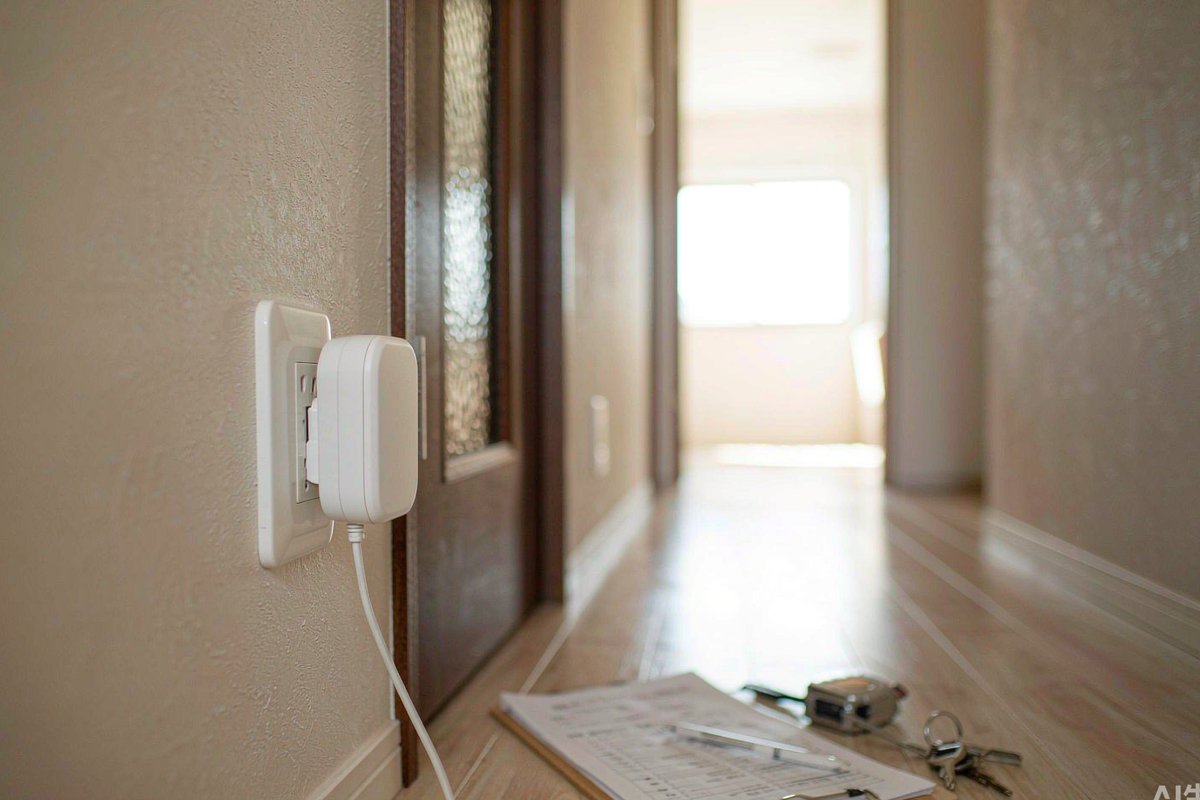
The listing photos are done, the kitchen is staged, and then a stranger walks your hallway with a clipboard and asks a question you have not thought about in years: where are the carbon monoxide detectors?
It is a small question that arrives late in a large process. By the time it is asked, you are weeks from closing, every repair has a schedule attached, and the cheapest possible fix has already passed. This guide covers what is actually being asked, who is asking it, and the handful of checks that turn a possible closing-day credit into a non-event.
Why this comes up at a sale and never before
Carbon monoxide detectors are one of the few safety items in a house that are installed once and then never thought about again. They do not fail loudly. They do not stop the water heater from working. A unit can sit on a hallway wall for a decade, past the date printed on its back, and nothing in daily life will ever notice.
A sale is the one event that forces the house to be looked at the way a stranger would look at it. That is the entire reason the question appears: not because selling changes the physics of carbon monoxide, but because it changes who is looking.
Three different parties may raise it, and they are asking for different reasons:
- The home inspector, who is working from a standards-of-practice checklist and documenting what they observe.
- The appraiser or lender, whose concern is whether the property meets the minimum property requirements attached to the loan program.
- The buyer, who may simply want documentation that the house has working detectors before they move a family in.
These are not the same question. Conflating them is where most seller anxiety comes from.
Code, lender, and buyer are three separate standards
This is the distinction that resolves most of the confusion, and it is worth stating plainly before anything else.
| Who is asking | What they are checking | What it usually means for you |
|---|---|---|
| Local code / authority having jurisdiction | Whether the dwelling meets the requirements that applied when it was built or last permitted | Relevant at sale only if your city or county runs a point-of-sale inspection program |
| Lender / appraiser | Whether the property meets minimum property requirements for the loan type | Usually satisfied by a working detector where the loan program names one; conventional, FHA, and VA programs differ |
| Home inspector | What is observed and reported, not what is legally required | A written observation, not a pass/fail ruling |
| Buyer | Whether they feel the house is ready to occupy | Negotiable — often resolved with a credit or a receipt |
An inspection report is not a legal judgment. It is a document that describes the condition of the house on one afternoon. Whether an observation becomes a repair request is a negotiation between two parties, not a ruling.
Where "required" actually comes from
Requirements for carbon monoxide alarms in the US are set at state and local level, and they vary in ways that surprise people. Some states cover all dwellings with a fuel-burning appliance or an attached garage. Some cover only new construction or only units that are being sold or rented. Some municipalities add a point-of-sale inspection on top of that.
Two practical consequences:
- What was required when your house was built is not necessarily what is required now. Most jurisdictions apply current requirements only when a property changes hands, is substantially renovated, or changes use. That is exactly why a sale is the moment it surfaces.
- Rental and owner-occupied rules are frequently different. The obligations that apply to a landlord handing keys to a tenant are not the same obligations that apply to an owner selling to a new owner. If you are deciding whether to sell or rent the property, the two paths are worth comparing directly — we covered the rental side in detail in carbon monoxide detector requirements for apartments and rentals.
Anything specific — which locations qualify, how many units, whether the requirement is hardwired or can be battery — should be confirmed with your local building department before you rely on it. A generalized rule from a website is not a substitute for the authority that actually has jurisdiction over your address.
The six findings that come up most often
Across the questions sellers send us, the same handful of observations account for most of the comments. None of them is expensive to resolve before listing. All of them are more annoying to resolve after an inspection.
1. No detector on the level with the bedrooms
The most common placement gap in older houses is not a missing detector in the basement — it is a missing detector near the sleeping areas. Most guidance in the US converges on having protection on each level that contains a bedroom, and outside the sleeping area itself.
If a house has one detector installed in a hallway that was added during a 1990s renovation and nothing upstairs, that is the finding. The fix is covered properly in how many CO detectors a home needs, which walks through the count by floor plan rather than by square footage.
2. A unit past its replace-by date
Every CO alarm has a service life, typically somewhere in the five-to-ten year range depending on the model, and a date printed or stickered on the housing. Inspectors check this because it is printed right on the unit and takes two seconds to read.
A detector can look fine, pass a button test, and still be past the date the manufacturer stated for the sensor. That date is the one finding that cannot be argued with, and replacing a unit is cheaper than the conversation. The reasoning behind service life — and how to read the date on yours — is in how long CO detectors last.
3. A unit installed in the wrong place
Placement problems read as "installed, but not useful." The recurring ones: mounted directly above a fuel-burning appliance, inside a few feet of a cooking appliance, in a bathroom where steam is routine, on an unheated ceiling, or immediately beside a supply vent.
If your detector is above the water heater, that is the finding. Height, distance from appliances, and the reasoning behind both are covered in CO detector placement and height.
4. A unit that is not actually running
Dead battery, battery removed during a renovation and never replaced, cord unplugged, painter's tape over a display, a battery-only unit with the pull tab still in place. Inspectors test units, and a silent detector is reported as non-functioning regardless of why.
Press and hold the test button on every unit in the house the week you list. Then do it again the morning of the inspection, because a low battery can announce itself in the interval — which is a chirp, not an alarm, and the two are easy to confuse; CO detector beeping patterns separates them.
5. No detector near an attached garage
An attached garage introduces a source that a purely interior plan does not have: a vehicle engine, in a space that shares a wall or a door with the living area. Whether or not your jurisdiction names it explicitly, inspectors notice when there is no protection anywhere between the garage and the bedrooms.
The mechanics of why that shared boundary matters — pressure coupling, the connecting door, the ceiling plane — are set out in CO alarms for attached garages.
6. Combination units doing a job nobody documented
A combination smoke and CO unit installed in one location satisfies two functions at once, which is efficient and completely legitimate. The finding appears when the house has one combination unit total and the seller assumes that covers a two-story floor plan.
Combination units are worth understanding before you buy replacements in a hurry. The trade-offs are laid out in the combination CO and gas detector buying guide, and the difference between what a smoke alarm and a CO alarm each respond to is in smoke detector vs carbon monoxide detector.
What to do 30 days before you list
This is the part that turns the topic from a risk into a checklist. None of it requires a contractor.
Week one — inventory. Walk the house and write down every detector: location, power source (battery, plug-in with battery backup, hardwired), and the date printed on the back. Most owners find they have fewer than they assumed and one they had forgotten entirely.
Week two — dates and power. Anything past its replace-by date gets replaced. Anything with a removable battery gets a fresh one, and you keep the receipt. Plug-in units get checked on both legs: does it run on the outlet, and does the backup still hold a charge. That second question is the one people skip, and it matters — does a CO detector work during a power outage covers what battery backup actually covers.
Week three — placement. Look at each location against the recurring problems above. Moving a unit that is above the water heater costs nothing.
Week four — document. Take a photo of each unit showing the date and the power source, and keep the replacement receipts in a folder. When a buyer asks, an answer with a receipt attached ends the conversation immediately.
If a house has a fuel-burning appliance the buyer will ask about — a gas range, a fireplace, a boiler — it is worth reading what those specifically change. Fireplace and CO detector placement, furnace and boiler CO detectors, and gas leak detection in the kitchen each cover one.
If you are rebuilding coverage anyway, the practical question is what to put back. A unit that shows the live reading rather than only sounding gives the new owners something a standard alarm does not — the VASAIKO HD16 safety detector overview is one example of that type.
If the inspection already happened
A CO detector observation is among the least expensive items that can appear on a report, and it is usually resolved one of three ways:
- Seller fixes before closing. Cheapest in cash terms if you do the work yourself, and it removes the item from the file.
- A credit at closing. Common when the buyer would rather choose their own units. Typically priced per unit.
- Buyer accepts as-is. Most likely when the report shows working detectors and one recommendation rather than an absence.
The one scenario worth avoiding is a re-inspection. A buy-side re-inspection is scheduled at the buyer's convenience, on a day you do not control, with a deadline attached.
Buyers: what to actually look at
If you are on the other side of this, the useful question is not "is there a detector." It is three narrower ones:
- How old is it? Read the date, not the appearance.
- Does it have a working power source right now? Press the test button yourself during the walkthrough.
- Is where it is mounted going to work? A detector over a range or in a bathroom has a predictable nuisance-alarm future, which is how detectors end up with the battery removed — the outcome everyone involved was trying to avoid.
If the house has a fuel-burning appliance you are not familiar with, or an attached garage, ask specifically where the protection is between that source and the bedrooms.
And if you move in wanting more than a sound — a unit that gives you the number so you can judge whether a reading near the garage door means anything — start with the VASAIKO HD16 safety detector overview.
Where a unit with a readout fits
Most CO alarms are binary. They are silent, or they are sounding, and in between they tell you nothing. That is a perfectly good design for the job they are built to do.
A unit that shows the live reading gives you something different: the ability to see a number instead of a state. In practice that answers questions a standard alarm cannot — whether the reading near a garage door is actually elevated or just noise, whether a unit that chirped twice last night was responding to something real, whether the value has come back down after you opened a door.
That is a monitoring layer, not a replacement. The alarm your jurisdiction and your loan program care about is the alarm that sounds. If the reading display is what you are after, CO detectors with a digital display explains what the number does and does not mean, and plug-in vs battery CO detectors covers the trade-off on power.
If a detector does sound and you are not sure why, that is a different guide: why CO alarms go off when nothing is burning and the basics of how to test a CO detector.
For new homeowners who want one starting point: the VASAIKO HD16 safety detector overview shows what a plug-in unit with a live reading looks like in practice.
Frequently asked questions
Do I legally need CO detectors to sell my house?
It depends entirely on your state and municipality. Some jurisdictions require CO alarms at point of sale, some only tie the requirement to new construction or rental use, and some have a local point-of-sale inspection program. Check with your local building department; do not rely on a general rule.
Will the home inspector fail my house if there is no CO detector?
Home inspectors do not pass or fail houses. They report observations. A missing or non-functioning detector is a common observation that becomes a negotiation item between buyer and seller.
Does an FHA or VA loan require CO detectors?
Loan programs have minimum property requirements that differ from each other and change over time. Whether a CO alarm is named, and in which locations, is a question for the specific loan program and the appraiser — not something to assume either way.
The buyer is asking for a credit for CO detectors. Is that normal?
Yes. Because units are inexpensive and the buyer may want to choose their own, a credit is one of the most common resolutions.
My detectors are hardwired. Does that change anything?
Hardwired units with battery backup are generally viewed favorably, but hardwiring does not exempt a unit from its service life. An inspector will still read the date.
Should I replace every detector before listing, or wait?
Replacing before listing is almost always the better trade. You control the timing, the model, and the placement, and you remove the item from the report entirely. Waiting means doing the same work on someone else's deadline.
The house has a combination smoke and CO unit. Is that enough?
It can be, depending on count and location. The common problem is not the type — it is having one unit covering a floor plan that needs more coverage than one location provides.
A detector chirped during the showing. What should I do?
A chirp is usually a low-battery or end-of-life signal, not a CO alarm. Replace the battery or the unit and keep the receipt. If it was a full alarm tone, that is a different matter and the house should be ventilated and the source investigated before anyone assumes it was nothing.
Does a CO detector need to be in the garage itself?
Guidance varies, and a detector mounted directly inside a garage is often exposed to exhaust by design of the space. The location that matters more in most plans is the boundary — the wall or door between the garage and the living space, and the level with the bedrooms.
The bottom line
The reason CO detectors come up at closing is not that they are complicated. It is that they are invisible until someone who has never lived in your house walks through it with a checklist.
Thirty minutes with a step stool and a fresh set of batteries handles most of it: know what you have, know how old it is, know that it runs, and know that it is somewhere sensible. Do that before you list, and the question becomes one you already answered.
If you want one device that adds a live reading to the alarms you already have, the VASAIKO HD16 safety detector overview is the place to start. For the numbers themselves — what a low reading means and when it matters — begin with safe CO ppm levels.
Related reading
- How many CO detectors a house needs
- CO detector placement and mounting height
- How long CO detectors last, and how to read the date
- Why CO alarms go off when nothing is burning
- Beeping vs chirping: what a CO detector is telling you
- How to test a CO detector properly
- CO detectors with a digital display
- Plug-in vs battery CO detectors
- CO alarms for an attached garage
- Carbon monoxide detector requirements for rentals
- Combination CO and gas detector buying guide
- CO detectors for short-term rentals and Airbnb
- What the UL 2034 standard actually covers
- Home gas leak detectors explained
- CO detector placement in a fireplace home
- Furnace and boiler CO detection
*This article is general information, not legal or code advice. Requirements for carbon monoxide alarms vary by state, county, and municipality, and change over time. Confirm anything specific with your local building department, your insurer, or the authority having jurisdiction for your address.*