
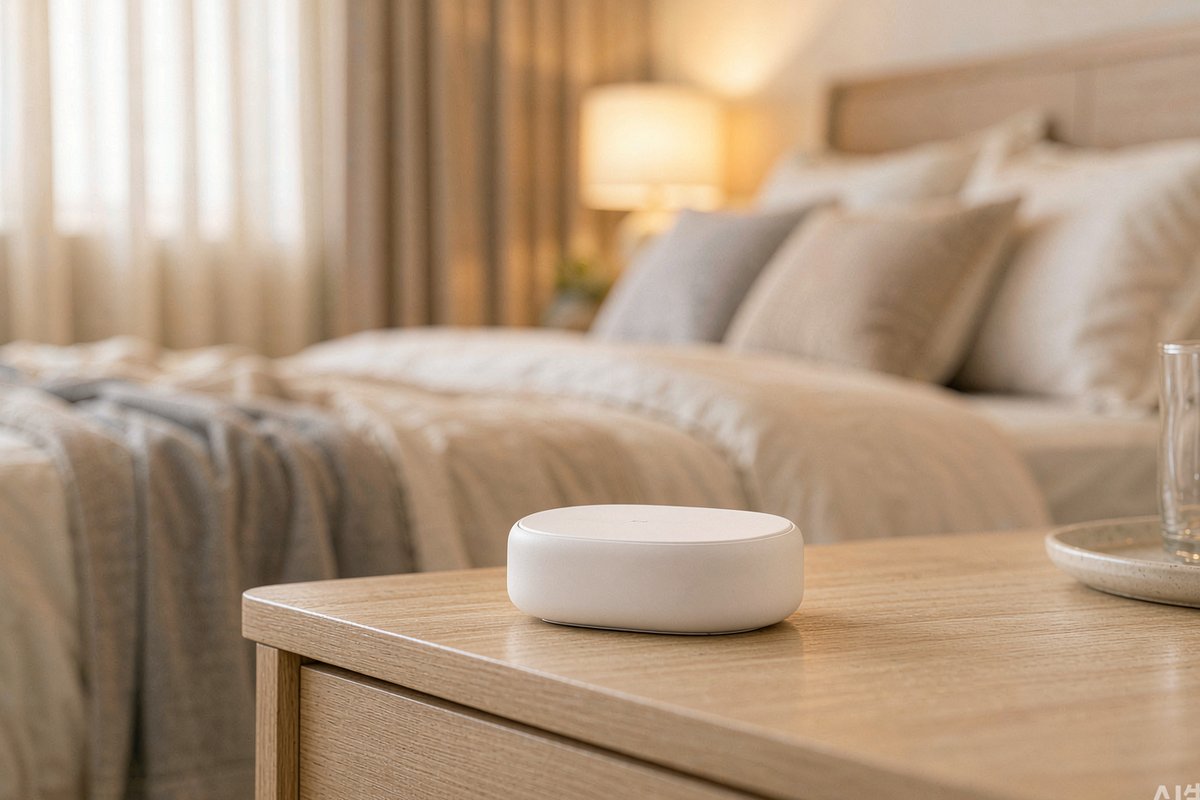
A host's carbon monoxide problem is not the same as a homeowner's. In your own house, you know which burner runs hot, which door stays shut in January, and what that one beep at 3 a.m. sounded like last time. Your guests know none of that — and they change every three days.
That gap is what makes a carbon monoxide detector for Airbnb listings worth thinking about properly. It is not only a safety device question. It is also a disclosure question, a documentation question, and a "someone else is operating my appliances" question. This guide walks through all four, with the practical decisions a host actually has to make: what to install, how many, where, how to check it between stays, and what to write down.
One boundary up front: this is general guidance, not legal advice. CO alarm requirements are set by state, county, and city code, and they change. Check your own jurisdiction's current rules with the local building or fire department before you treat any checklist — including this one — as compliance.
Why Short-Term Rentals Behave Differently
Three structural differences separate a rental from an owner-occupied home, and each one changes what "adequate detection" looks like.
The operator changes constantly. A guest who has never used a gas range with a pilot light, or who has never seen a wall-mounted propane heater, will use your appliances differently than you do. Instructions in a welcome book help, but instructions are not a control.
Nobody present knows the baseline. In your own home, you notice when the water heater starts running longer than usual. A guest has no baseline to compare against, so the first sign of trouble tends to be an alarm — or a symptom.
The liability sits with one person who is not in the building. If something goes wrong, the questions asked afterward are about what you installed, what you disclosed, and what you maintained. Those are three separate records, and hosts routinely have only the first.
This is why the rest of this guide spends as much time on paperwork as on hardware. The detector is the easy part.
What Platforms Ask For, and What the Law Requires
Keep these two layers separate in your head, because they are constantly confused.
Platform disclosure. Short-term rental platforms generally include safety-device fields or amenity checkboxes in the listing editor — a place where you indicate whether smoke and carbon monoxide alarms are present. Filling that in accurately matters for two reasons: a guest may filter on it, and an inaccurate disclosure is worse than no disclosure if anything is later reviewed. Platform policies get revised; read the current version of your platform's safety page rather than relying on a summary, including this one.
Legal requirement. Whether a CO alarm is *mandatory* in your unit is a question of state and local code, not platform policy. Many jurisdictions tie residential CO alarm requirements to the presence of fuel-burning appliances or an attached garage, and many reference model codes for dwelling units. Some apply the rule to rentals specifically, and some apply it regardless of tenure. There is no single national answer for short-term rentals, which is exactly why "Airbnb says I need one" and "the law says I need one" are two different sentences.
The practical takeaway: install to the stricter of the two standards you can identify, then disclose accurately. If you also operate long-term rentals, the analysis differs again — the landlord-tenant side is covered separately in our guide to carbon monoxide detector law for apartments.
Standards to Look For on the Box
When you shop, the label language matters, and the specific wording matters more than the marketing summary.
- UL 2034 is the standard for single- and multiple-station carbon monoxide alarms in the US. A product described as tested to UL 2034 standards has been evaluated against that performance standard. That phrasing is not the same thing as a certification claim, and reputable listings will be precise about which one they mean. We explain the distinction in plain language in UL 2034 explained.
- UL 1484 covers residential gas detectors — the combustible-gas half of a combination unit.
- UL 217 is the smoke alarm standard, relevant if you are buying a combination device that also claims smoke detection.
- CE and FCC markings and RoHS compliance cover the electromagnetic and material-hazard side rather than CO sensing performance.
A multi-function unit that covers CO plus combustible gas plus smoke can be a sensible way to cover a rental with fewer devices and fewer things to test, provided each claimed function is backed by the standard that applies to it. Our combination CO and gas detector buying guide goes through the trade-offs in more detail than a listing page will.
How Many Detectors Does a Rental Need?
Hosts routinely under-buy here, because the question gets answered with "one per unit" when the real answer is driven by layout.
The working rule most guides converge on is one alarm on each sleeping level, plus one near each sleeping area, and additional coverage where a fuel-burning appliance or an attached garage introduces a source. A studio with a gas water heater in a closet and a one-bedroom with a fireplace on the ground floor and two bedrooms upstairs do not need the same number of devices.
Rather than repeat the full math here, use the dedicated walkthrough in how many CO detectors you need — it breaks the answer out by floor plan, which is the only way it can be answered honestly.
What is worth adding for rental-specific cases:
- List the sleeping areas as a guest would find them. A sofa bed in a den, a bunk alcove, or a converted finished basement all count as sleeping space even if the listing calls them something else.
- Count attached and semi-attached structures. A rental with an attached garage shares a wall and often a door with the living space, which is a materially different risk profile than a detached unit.
- Finished lower levels need their own decision. Walk-out basements used as bedrooms are common in short-term rentals and frequently missed. See basement CO alarms.
Placement Rules That Survive Guest Turnover
Placement is where good intentions go to die, because a detector placed for a homeowner's habits gets moved by the first guest who wants the outlet.
- Height. Carbon monoxide mixes fairly evenly with room air, so mounting height is far less critical than it is for smoke or propane. The practical rule is to place the unit where the display can be read at eye level and where it will not be unplugged. Our placement and height guide has the detail, including why the "CO rises" assumption is wrong.
- Keep it plugged in. A plug-in unit with a battery backup is the configuration that tolerates guests best: it stays powered through a stay, and it keeps working during an outage. If you are weighing the two designs, plug-in versus battery CO detectors lays out the trade-off directly.
- Avoid the spots that cause false alarms and unplugging. Directly above a range or oven, right next to a bathroom door that gets steamy, immediately beside a fireplace, and behind furniture are the four that cause the most service calls. The full list is in what causes CO detector false alarms.
- Label it. A small card on the welcome book — "this device is a carbon monoxide monitor; if it alarms, open a window, step outside, and message me" — converts a panicked guest into a report.
The Amenities That Raise the Risk Profile
Every comfort feature a host adds to win bookings can also add a combustion source. Walk your own listing and score it honestly.
| Amenity | What it changes | Mitigation | Related guide |
|---|---|---|---|
| Wood-burning fireplace | Guest-operated combustion, chimney and damper variables | CO alarm in the room, damper instructions, annual chimney check | Fireplace CO risk |
| Portable space heater | Often electric (no CO) but sometimes fuel-fired; also an outlet-load issue | Confirm fuel type in writing; ban fuel-fired portables if unsure | Space heater CO risk |
| Gas water heater or boiler | Runs unattended, often in a closet or utility space | Alarm on the sleeping level and near the appliance | Water heater CO |
| Gas range or cooktop | Guest-operated, highest-usage appliance in the unit | Do not place the alarm directly above it; keep oven use out of the heating plan | Kitchen gas leak alarms |
| Backup generator | Outdoor placement is non-negotiable and frequently violated | Written rule at the unit; never indoors, never in an attached garage | Generator CO safety |
| Propane grill or fire pit stored indoors | Storage leak risk, not just use risk | Store cylinders outdoors, never in the unit | Home gas leak detectors |
The pattern across all six: the amenity is fine, the *unmanaged* amenity is the problem. Written instructions plus detection is the combination that holds up. If your listing has two or more of these rows, it is worth covering CO and combustible gas with a single device rather than two — the VASAIKO HD16 6-in-1 monitor is built for exactly that overlap.
Why a Readable Display Is Worth More in a Rental
This is the one place where a rental buyer should make a different choice than a homeowner would.
In your own home, a beeping alarm is a decision you make yourself — you look around, you smell, you open a window. In a rental, the person hearing the alarm has no context, and the person with context is twenty minutes away. A unit that shows a live ppm reading turns an ambiguous event into a message: *"it says 42 and it's going up"* is actionable remotely. *"Something is beeping"* is not.
There is a second benefit that matters more over a season. Low-level, recurring events — the kind that leave no trace by the time you arrive — are visible on a display and invisible on a beep-only unit. A guest can photograph a reading. That photo, with a timestamp, is the difference between a maintenance ticket you can act on and a vague complaint you cannot.
If you want the full argument for display units, including what the number actually means and how to read a trend rather than a snapshot, see CO detectors with a digital display. For context on what different levels mean, the safe CO ppm levels chart is the reference to keep in the welcome book.
A display unit is a supplemental monitor. It adds information to the alarm layer; it does not replace a code-required alarm where one is required. Keep both concepts in the listing description — accuracy there protects you.
Between-Stay Checks: A Turnover Checklist
A detector you installed and never touched is a detector you cannot vouch for. Build the check into the cleaning turn, not into a separate annual reminder you will forget.
Every turnover (2–5 minutes):
- Press and hold the test button; confirm the alarm sounds.
- Look at the display or status LED: normal state, no fault indication.
- Confirm the unit is still plugged in and in its documented position.
- Check for a peak-reading memory event since the last stay, and photograph it if one exists.
- Note the check in the turnover log with the date.
Every quarter:
- Vacuum the vents gently; dust and renovation debris are a real fault source.
- Verify the backup battery still holds a charge by unplugging the unit for a few minutes and confirming it stays live.
- Re-read the end-of-life indication. CO sensors degrade; they do not fail loudly at the end. Typical service life is measured in years, and the unit should tell you when it is done — see how long CO detectors last.
Every listing change:
- If you add an appliance, add a fireplace, or convert a space into a bedroom, redo the count. The placement answer changes.
Step 4 only works if the unit actually keeps a peak reading — a beep-only device gives you nothing to photograph. That memory feature is one of the quiet reasons a readable monitor earns its place in a rental, and it is worth confirming before you buy; the HD16 spec page lists what the display retains.
A proper testing procedure, including what a test button does and does not prove, is in how to test a carbon monoxide detector. And when a guest does report a beep, why your CO detector is beeping will help you distinguish alarm patterns from end-of-life chirps over the phone.
Documentation: The Layer Most Hosts Skip
If an incident is ever reviewed, three records get asked for. Have all three, in a folder per property.
- Installation record — what you installed, where, and when. Photos of each unit in place are ideal.
- Maintenance record — the turnover log. A spreadsheet with dates and initials is entirely sufficient; it does not need to be formal.
- Disclosure record — a screenshot of the listing's safety fields as you set them, dated.
None of this is onerous if it is built into an existing routine. All of it is impossible to reconstruct after the fact.
Worth adding: a one-page guest card near the device stating what it monitors, what the alarm sounds like, and what to do. Guests who know what a device is do not unplug it.
Four Mistakes Hosts Make
Buying one device for a two-bedroom listing. The count follows the floor plan, not the unit count. See how many you need.
Mounting it above the stove to "cover the gas appliance." Too close to a cooking source produces nuisance alarms, and a nuisance alarm is a device that gets unplugged.
Treating the listing checkbox as compliance. Disclosure and code compliance are different obligations from different authorities.
Letting the guest be the maintenance plan. If the only time the detector is checked is when a guest complains, you have no maintenance record — which is the record that matters.
Where a Multi-Pack Makes Sense
If you operate more than one property, or one property with more than one sleeping level, buying in quantity is not just a cost question — it is a consistency question. Identical units across a portfolio mean one test procedure, one set of instructions, one spare in the closet, and one thing to photograph.
The device we build for this role is a plug-in 6-in-1 monitor — carbon monoxide, combustible gas, smoke, humidity, temperature, and a lithium backup — with a live digital readout and roughly eight hours of battery backup during an outage. It is a supplemental monitor designed to sit alongside your existing alarm layer and give you and your guests a number instead of a guess. It is tested to UL 2034, UL 1484, and UL 217 standards, CE and FCC certified, and RoHS compliant, and it is available in single and multi-packs for exactly the portfolio case described above.
You can see the full specification and current pack options on the VASAIKO HD16 safety detector page.
FAQ
Does Airbnb require a carbon monoxide detector?
Platforms generally ask hosts to disclose whether safety devices such as smoke and CO alarms are present, and platform policies change over time — read the current version in your listing editor. Whether an alarm is *legally* required is determined by state and local code, which varies. Install to the stricter standard you can identify and disclose accurately.
How many CO detectors does a vacation rental need?
It depends on the floor plan rather than the unit count: one on each sleeping level and near each sleeping area, plus coverage where a fuel-burning appliance or attached garage introduces a source. Our dedicated guide breaks it down by layout.
Can I use a plug-in detector in a rental?
Yes, and for rentals it is often the better choice, because guests are less likely to remove it than a battery unit they may want to silence. Look for one with battery backup so it keeps working during an outage. The trade-off is covered in plug-in versus battery.
Where should I put it so guests do not unplug it?
At eye level where the display can be read, away from the stove, the bathroom door, and the fireplace, and on a circuit that is not switched. A short card explaining what the device is reduces unplugging more than any mounting trick.
Should I get a unit with a digital display?
For a rental, the case is stronger than for an owner-occupied home, because a guest can read you a number over the phone and because low-level events that leave no trace become visible. See digital display units.
Does a CO detector also cover propane or natural gas leaks?
Only if it is built for it. Combustible-gas sensing is a different function under a different standard (UL 1484 for residential gas detectors). If your unit has propane or natural gas, confirm the device explicitly covers combustible gas — this explainer covers when it matters.
How often should I replace detectors in a rental?
CO sensors have a finite service life, and the unit reports end-of-life rather than failing silently. Replacement intervals and the signals to watch for are in how long CO detectors last.
What should I do if a guest reports an alarm?
Take it as real until proven otherwise: have them open windows, move outdoors, and tell you the reading if the unit displays one. Then ventilate and investigate before the next guest. Do not silence and re-list.
The Bottom Line
For a short-term rental, carbon monoxide detection has four parts, and only one of them is hardware: install to a layout-driven count, place the units so guests will not defeat them, check them on every turnover, and keep three records — installation, maintenance, disclosure.
Hosts who do all four rarely end up in the position of explaining afterward why they did not.
If you are setting up or re-doing detection across a listing — or across several — start with the HD16 6-in-1 monitor: plug-in with battery backup, a live ppm readout your guests can actually report to you, and multi-packs sized for portfolios.
*This article is general information, not legal or medical advice. Always follow the manufacturer's instructions and your local code requirements. Carbon monoxide exposure symptoms and health effects are covered separately in CO poisoning symptoms — if you suspect exposure, leave the space and contact emergency services or a poison control centre.*